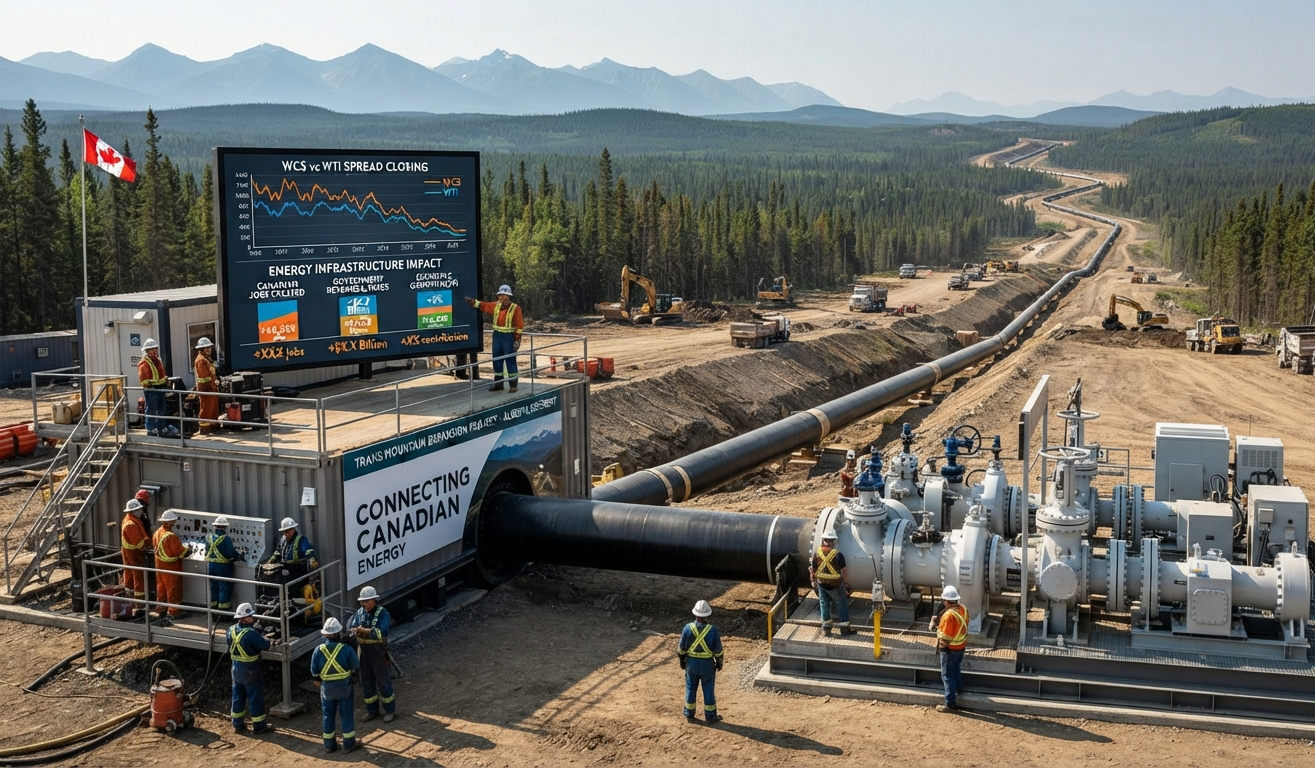
For decades, the health of Alberta’s economy—and by extension, Canada’s overall fiscal standing—has been deeply tied to a single, critical variable: pipeline capacity.
While global headlines focus primarily on West Texas Intermediate (WTI) crude prices, Alberta’s energy producers sell Western Canadian Select (WCS), a heavy crude blend that historically trades at a discount to WTI. The size of that price gap, known as the WCS-WTI differential, directly impacts corporate revenues, provincial budget surpluses, federal tax receipts, and employment across Western Canada.
With major market access developments and expanding transportation infrastructure shaping the 2026 economic outlook, understanding how pipeline capacity directly governs Canadian economic prosperity is essential for residents, investors, and newcomers alike.

1. What Is the WCS-WTI Differential?
To understand Alberta’s energy economy, one must distinguish between the two primary North American crude benchmarks:
- West Texas Intermediate (WTI): A light, sweet crude oil produced in the United States, serving as the main North American price benchmark.
- Western Canadian Select (WCS): A heavy, sour crude blend produced in Western Canada, primarily from Alberta’s oil sands, mixed with lighter diluents to allow pipeline transport.
Because WCS is heavier and contains more sulfur, it requires more complex refinery processing than light crude. Therefore, WCS naturally trades at a baseline discount to WTI.
However, when pipeline takeaway capacity becomes restricted, Alberta oil builds up in storage facilities. Producers are then forced to move excess crude via rail—a significantly more expensive transport method—causing the WCS discount to widen dramatically.
2. Why Pipeline Takeaway Capacity Is Everything
Unlike refined petroleum products, raw heavy crude cannot simply be stored indefinitely or shipped cheaply without dedicated infrastructure.
Historically, when Western Canadian crude production exceeded total export pipeline capacity, the WCS-WTI differential blew out to $30 or even $40 per barrel.
PIPELINE BOTTLENECK CYCLE
- High Oil Sands Production —> Export Pipelines Fill to Capacity
- Expensive Crude-by-Rail Substituted — > Regional Glut in Alberta
- WCS Differential Widens —> Severe Loss in Royalties & Tax Revenue
When takeaway bottlenecks occur, every extra dollar in discount represents billions of dollars lost in national income:
- Provincial Royalty Losses: Alberta collects royalties based on the realized price of WCS. A wider differential shrinks provincial revenues immediately.
- Reduced Capital Expenditure (CapEx): Energy companies scale back expansion projects, drilling budgets, and hiring plans when price realizations fall.
- Federal Tax Revenue Reduction: Lower corporate profits mean reduced federal corporate income tax collections, affecting public spending across all provinces.
3. Structural Shifts in Market Access
The economic trajectory of Western Canada relies heavily on expanding takeaway capacity to international tidewater ports and US refining centers.
Market access initiatives aim to achieve three primary goals:
- Diversification Away from Single-Buyer Reliance: Historically, nearly all Canadian crude exports were locked into US Midwest and Gulf Coast markets. Access to Pacific marine terminals enables direct exports to fast-growing Asian markets.
- Narrowing the Structural Discount: Expanding pipeline bottleneck capacity stabilizes the WCS differential, bringing realized prices closer to global heavy-crude benchmarks.
- Lowering Transport Costs: Moving crude by pipeline costs roughly $7 to $10 less per barrel compared to crude-by-rail transport, delivering higher net profit margins directly back to producers.
4. Economic Ripple Effects Across Alberta and Canada
Energy infrastructure projects generate far broader economic activity than just immediate oil sands operations.
A. Provincial Budget Sensitivity
Alberta’s fiscal budget is notoriously sensitive to energy prices. A sustained $1 change in the price of WCS crude or a narrowing of the differential by $1 can impact the provincial government’s annual revenue by hundreds of millions of dollars. Stable pipeline capacity protects provincial surpluses, funding healthcare, education, and infrastructure without requiring broad-based provincial sales taxes.
B. High-Wage Employment and Trades
The energy sector maintains one of the highest wage multipliers in Canada. Stable energy price realizations incentivize sustained long-term capital investment, supporting thousands of specialized jobs in heavy engineering, welding, logistics, environmental management, and digital automation.
C. Canadian Dollar (The “Loonie”) Valuation
Canada’s foreign exchange rate is strongly influenced by terms of trade and energy export values. Higher realized prices for Canadian energy exports strengthen foreign currency inflows, providing underlying support for the Canadian dollar.
5. Future Challenges: Environmental Standards and Global Competition
While takeaway capacity improves market access, Alberta’s energy sector faces evolving global and domestic headwinds:
- Emissions Reduction Commitments: Producers are investing heavily in carbon capture, utilization, and storage (CCUS) projects through initiatives like the Pathways Alliance to lower emissions per barrel.
- Global Energy Demand Volatility: Shifting trade dynamics and energy transition policies across G7 nations mean capital discipline remains a top priority for oil sands operators.
- US Refinery Demand Dynamics: The US Gulf Coast remains the world’s largest refining hub for heavy crude, making ongoing diplomatic and economic trade alignment between Ottawa and Washington critical.
Final Thoughts
Pipeline capacity is far more than a debate about steel in the ground—it is the foundational arterial system of Canada’s resource economy.
When pipeline capacity aligns with production, the WCS-WTI differential stabilizes, generating predictable royalties, strong capital investment, and high-paying jobs across Alberta.
At Maple Curiosity, we will continue to track energy infrastructure metrics, commodity pricing trends, and macroeconomic developments across Canada.
Leave a Reply