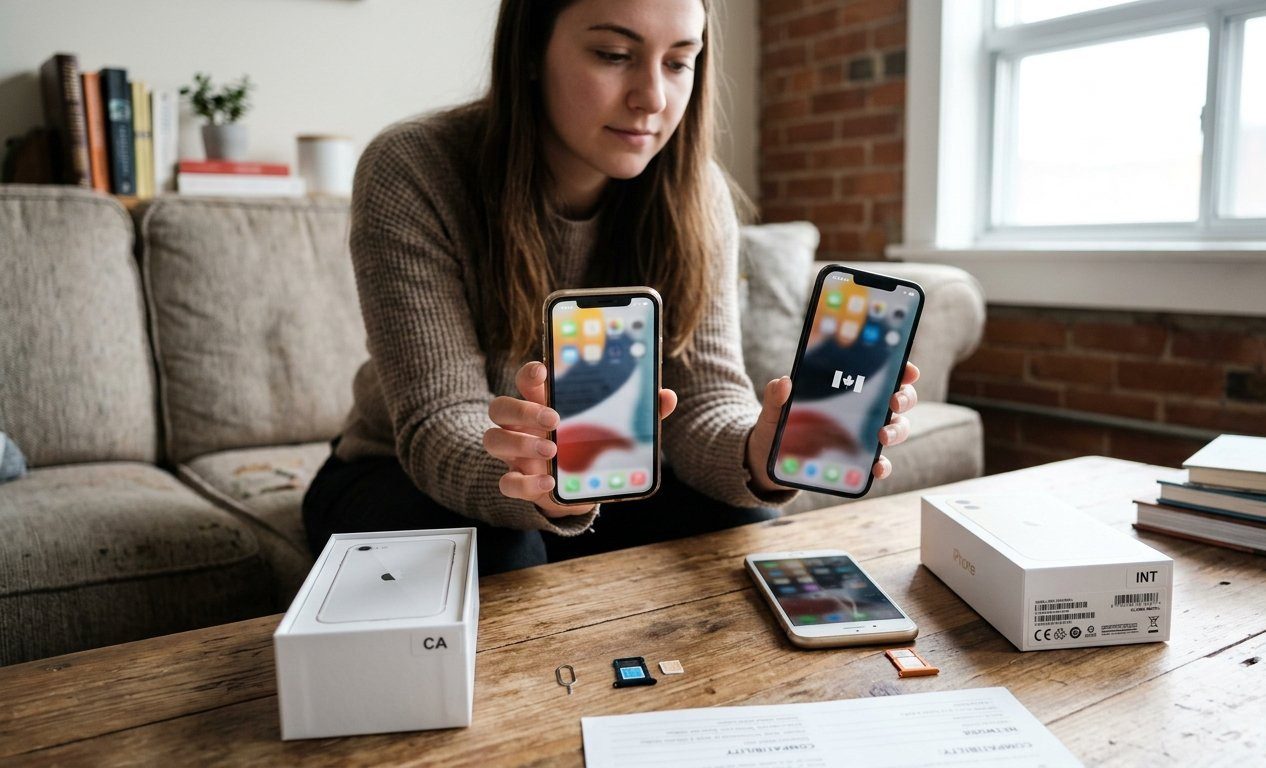
An unlocked smartphone can accept another carrier’s SIM card and still fail to make full use of that carrier’s network.
That distinction became clearer after a new CRTC decision issued on September 25, 2026.
The case involved a consumer who asked the regulator to investigate Canadian wireless carriers’ device compatibility and certification practices, arguing that some technically capable bring-your-own-device phones cannot access Voice over LTE or Wi-Fi Calling.
The CRTC declined to launch the broader proceeding based on the facts presented.
What did the CRTC case involve?
The applicant argued that Canadian wireless providers restrict access to IMS-based voice services, including VoLTE and Wi-Fi Calling, to devices that carriers have approved or certified.
As a result, the applicant said some BYOD customers can own phones that appear technically capable of these features but still cannot use them on a chosen Canadian network.
The CRTC reviewed the application and issued its response on September 25.
The official decision is contained in a CRTC Secretary General letter on device compatibility and IMS voice services.
The CRTC did not order carriers to support every imported phone
The regulator concluded that the information presented largely concerned compatibility between a particular device and a particular network.
The CRTC noted that the device involved had not been manufactured for use or sale in Canada.
It also said that the phone did not have the necessary technical configurations to access the IMS-based voice services on the chosen carrier’s network and was not certified for the Canadian market.
Based on those circumstances, the CRTC decided that a broader public proceeding on carrier compatibility and certification practices was not warranted.
What is VoLTE?
VoLTE stands for Voice over LTE.
It allows voice calls to be carried over a carrier’s 4G LTE network rather than relying on an older voice network.
Modern phones and networks use several interconnected technical systems to make VoLTE work, including device firmware, carrier profiles, network configuration and IMS—the IP Multimedia Subsystem.
A phone supporting LTE data does not automatically prove that every carrier’s VoLTE implementation will work on that model.
What is Wi-Fi Calling?
Wi-Fi Calling allows supported voice calls and related services to operate over a Wi-Fi connection while still integrating with the mobile carrier’s service.
It can be useful in a basement, large building or other place where cellular reception is weak but Wi-Fi is available.
Like VoLTE, it depends on cooperation between the phone’s software configuration and the carrier’s network.
Seeing a “Wi-Fi Calling” option in a phone menu does not necessarily guarantee the feature will activate on every Canadian provider.
Unlocked and compatible are not the same thing
This is the main practical lesson for consumers.
A network-unlocked phone is not restricted to one carrier’s SIM.
A compatible phone must also support the appropriate frequencies, network technologies, software profiles and other requirements for the carrier it will use.
A phone can therefore be unlocked but still have limited functionality on another network.
Maple Curiosity’s Canada locked-cellphone guide explains the separate CRTC rules governing carrier locking and unlocking.
Canadian certification is another separate issue
Innovation, Science and Economic Development Canada regulates radio equipment placed on the Canadian market.
ISED says wireless equipment must meet applicable Canadian technical requirements before it can be imported for distribution or offered for sale in Canada.
Certified equipment receives a technical acceptance certificate or equivalent certification and is listed in Canada’s Radio Equipment List.
The purpose includes reducing harmful radio interference and ensuring compliance with requirements such as radio-frequency exposure limits.
ISED’s official wireless equipment certification guidance explains the system.
Buying a phone overseas can therefore create extra risk
An international version of a phone can look almost identical to the Canadian model while using different radio bands, firmware or carrier configurations.
That difference may not be obvious when browsing an online marketplace.
A buyer could successfully insert a Canadian SIM and use mobile data but later discover that VoLTE, Wi-Fi Calling or another network-specific feature is unavailable.
This does not happen to every imported device, but it is a risk worth checking before purchase.
The model number matters more than the marketing name
Manufacturers often sell several regional versions under the same consumer-facing product name.
Two phones called by the same series name can have different exact model numbers.
Before buying, consumers should check the complete model number against the manufacturer’s Canadian specifications and the carrier’s compatibility information.
Checking only the product name or storage size can miss important regional differences.
Carrier frequency support is only part of the check
Many buyers look at a list of LTE or 5G bands and assume matching frequencies guarantee full compatibility.
Frequency support is important, but the CRTC case shows why it is not the entire story.
IMS voice services can also depend on technical configurations and carrier integration.
A phone can support the correct LTE band yet still fail to activate a carrier-specific voice feature.
Why this matters as older networks disappear
Network modernization makes advanced voice compatibility increasingly important.
If a provider relies more heavily on LTE and newer technologies for voice service, a device that cannot access the required voice implementation can become much less practical even if its mobile data continues working.
Consumers keeping older or imported phones for several years should therefore re-check compatibility when carriers announce network changes.
What should you check before buying a BYOD phone?
There are several useful checks to make before spending money on an imported or second-hand device.
- Confirm the exact model number.
- Check that the model is intended for the Canadian market.
- Check the carrier’s compatibility information.
- Confirm LTE and 5G band support.
- Ask specifically about VoLTE and Wi-Fi Calling.
- Check whether the model appears in Canada’s applicable equipment certification records.
- Confirm that the phone is network-unlocked.
These checks address different problems. Unlock status alone cannot answer all of them.
A cheaper imported phone can still cost more if key services do not work
Consumers often import smartphones because the purchase price is lower or because a particular model is unavailable through Canadian retailers.
The saving can disappear quickly if the device has to be replaced after discovering that a critical network feature is unsupported.
For that reason, price comparisons should include compatibility—not simply the hardware price.
Maple Curiosity’s Best Cell Phone Plans in Canada 2026 guide explains the service-plan side of reducing wireless costs.
Changing carriers can also reveal compatibility differences
A phone that works perfectly on one Canadian network does not guarantee identical functionality on another.
The device may support the required radio frequencies but encounter a difference in carrier-supported features or configuration.
Anyone switching providers should therefore confirm compatibility before cancelling the existing service, particularly if the phone was purchased outside Canada.
Canada’s Internet and telecom disclosure rules are also continuing to evolve. Maple Curiosity’s Canada Internet Plan Rules 2027 guide covers separate CRTC changes involving pricing, latency and typical Internet speeds.
What the September 25 decision does not say
The CRTC did not establish a rule saying that every imported phone must be blocked.
It also did not conclude that every carrier compatibility restriction is automatically acceptable.
The Commission’s letter addressed the specific application before it and concluded that those circumstances did not justify opening the requested broader public proceeding.
That distinction matters because a future complaint involving different facts could raise different regulatory questions.
The practical difference to remember
Canadian consumers now have strong rules around network locking, but unlocking is only one part of device portability.
A phone can be legally unlocked and still lack the hardware, certification or software configuration needed for all services on a Canadian network.
Before buying an imported device, the safest question is not simply “Is this phone unlocked?”
It is: “Does this exact model support the Canadian carrier and every feature I actually need?”
Leave a Reply