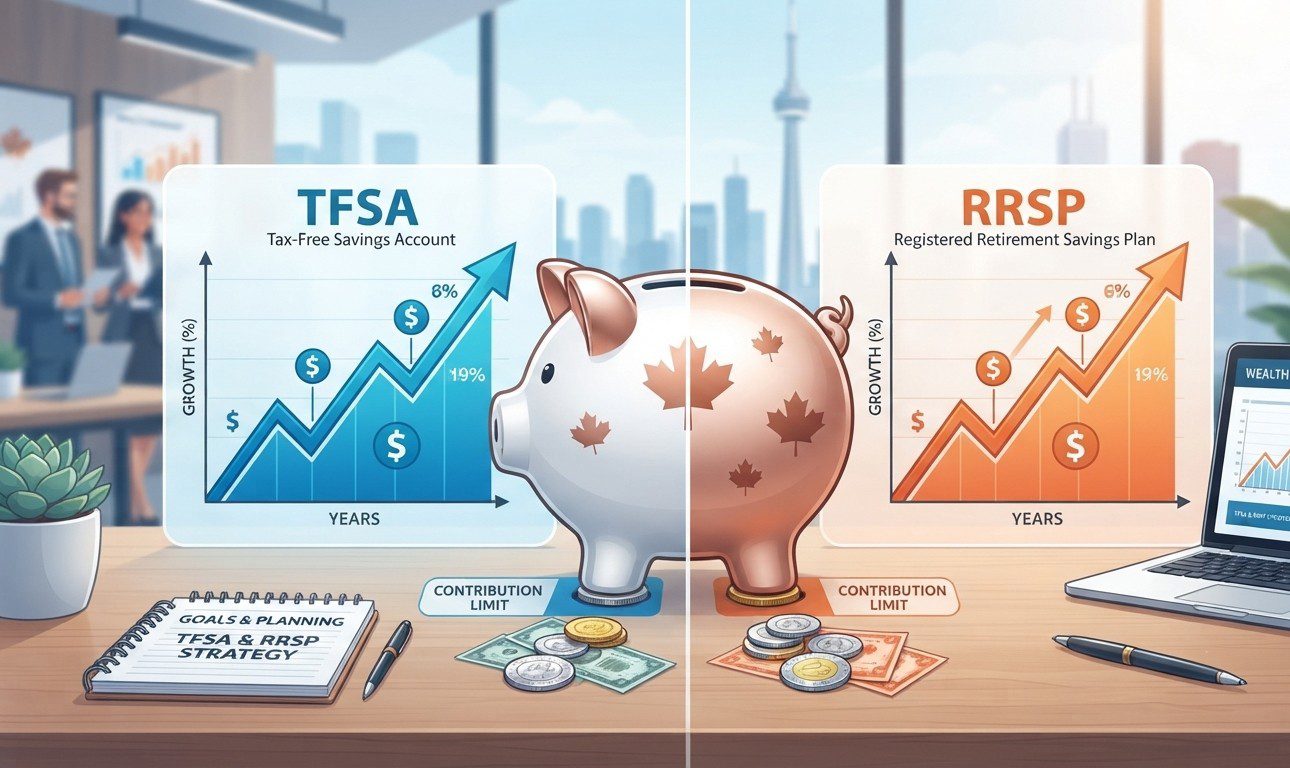
Choosing where to invest your hard-earned money is one of the most critical financial choices for Canadian residents. Both the Tax-Free Savings Account (TFSA) and Registered Retirement Savings Plan (RRSP) offer tax advantages, but they serve very different financial goals.
Understanding how tax brackets, withdrawal terms, and annual contribution limits work will ensure you pick the right savings vessel for your current life stage.
1. Core Differences Between TFSA and RRSP
The core distinction lies in when you receive your tax benefits:
- TFSA (Tax-Free Savings Account): You contribute using after-tax income. While contributions do not reduce your income taxes today, all investment growth and withdrawals are 100% tax-free at any time.
- RRSP (Registered Retirement Savings Plan): You contribute before-tax income. Your contributions provide an immediate tax deduction on your tax return, but future withdrawals in retirement are taxed as standard income.
2. 2026 Contribution Limits & Rules Comparison
| Account Feature | Tax-Free Savings Account (TFSA) | Registered Retirement Savings Plan (RRSP) |
| Tax Advantage | Tax-free growth and withdrawals | Upfront tax refund/deduction |
| Annual Limit Formula | Fixed federal dollar amount | 18% of prior year earned income (up to cap) |
| Withdrawal Impact | Unused room restored the following year | Unused room is permanently lost upon withdrawal |
| Ideal For | Short-to-mid term goals, flexible funds | Long-term retirement planning, high-income years |
3. Coordinating Registered Accounts with Federal Benefits
- Protect Your Income-Tested Benefits: TFSA withdrawals do not count as income, preventing clawbacks on government benefits. Calculate your child payouts using our 🔗 Canada Child Benefit (CCB) 2026 Guide.
- Optimize Housing Down Payments: High-income earners can pair RRSP contributions with first-home buyer plans—see our breakdown on 🔗 FHSA vs HBP Guide.
- Check Official Contribution Room: Always verify your exact lifetime limits prior to transferring funds through your secure 🔗 CRA My Account Setup.
4. Frequently Asked Questions (FAQ)
Can I contribute to both a TFSA and an RRSP at the same time?
Yes! If you have available contribution room in both accounts, you can divide your savings across both plans to optimize both short-term flexibility and long-term tax deductions.
What happens if I over-contribute to my TFSA or RRSP?
The Canada Revenue Agency (CRA) charges a penalty tax of 1% per month on the excess contribution amount for every month it remains in your account.
💬 Editor’s Note & Personal Insights
If you are currently in a lower tax bracket (e.g., earning under $50,000), prioritize filling your TFSA first. Save your valuable RRSP contribution room for higher-earning years when tax deductions yield a much higher tax refund!
Leave a Reply