Choosing between a Tax-Free Savings Account (TFSA) and a Registered Retirement Savings Plan (RRSP) is one of the most important financial decisions Canadians make.
Both accounts allow investments to grow with significant tax advantages, but they work in fundamentally different ways.
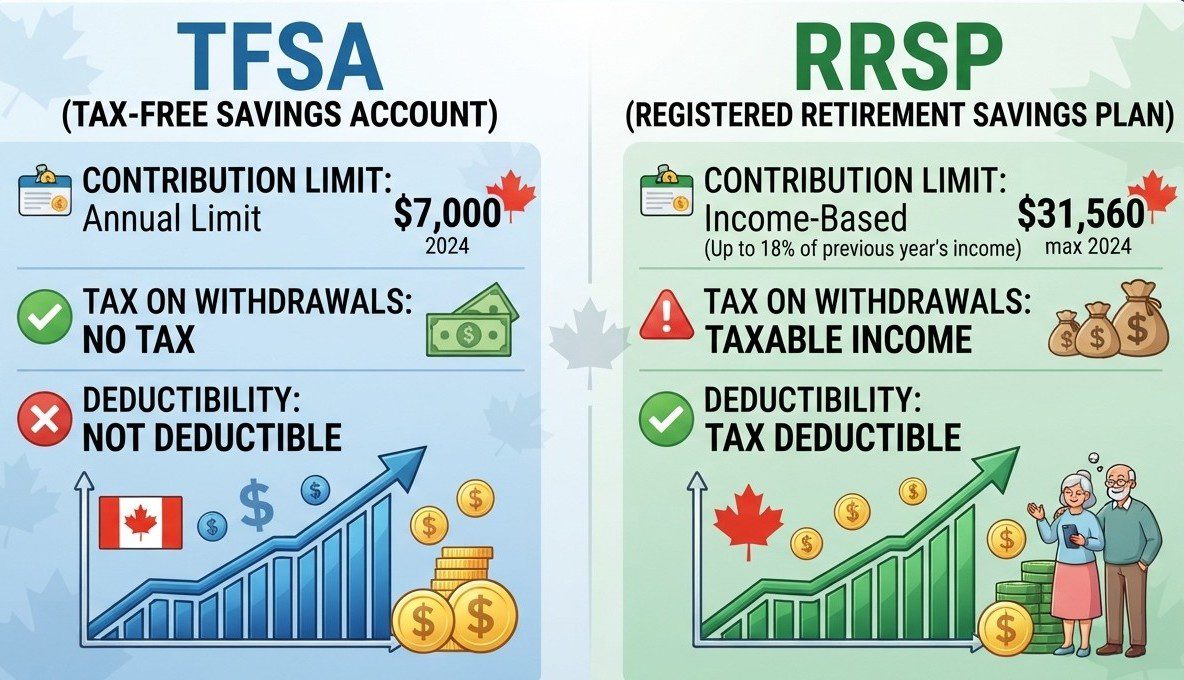
A TFSA uses money that has already been taxed and allows eligible withdrawals to remain tax-free. An RRSP can provide a tax deduction when you contribute, while regular withdrawals are generally taxable later.
The better choice depends on your income today, your expected future tax rate, employer benefits, retirement plans and how much flexibility you need.
For many Canadians, the real question is not “TFSA or RRSP?”
It is:
“Which account should I use first, and when should I start using the other?”
1. TFSA vs RRSP: The Main Difference
The easiest way to compare the two accounts is to ask when the tax advantage occurs.
TFSA
TFSA contributions do not generate an income-tax deduction.
However, investment income earned inside the account can generally grow tax-free, and eligible withdrawals can be made tax-free.
The Canada Revenue Agency provides a detailed explanation in its official TFSA guide.
RRSP
Eligible RRSP contributions can generally be deducted from taxable income, up to your available RRSP deduction limit.
Investment income is generally not taxed while it remains inside the RRSP.
However, regular withdrawals are normally taxable and must generally be reported as income.
You can review the CRA’s official RRSP information.
That makes an RRSP primarily a tax-deferral tool, while a TFSA provides tax-free eligible withdrawals.
2. TFSA vs RRSP Comparison for 2026
| Feature | TFSA | RRSP |
|---|---|---|
| 2026 annual dollar limit | $7,000 | $33,810 RRSP dollar limit |
| Personal available room | Can include unused previous room | Depends on individual CRA calculation |
| Contribution deduction | No | Generally yes |
| Growth inside account | Generally tax-free | Tax-deferred |
| Regular withdrawals | Tax-free | Generally taxable |
| Withdrawal room restored | Yes, following calendar year | Generally no |
| New room requires earned income | No | Generally based partly on earned income |
| Unused contribution room | Carries forward | Carries forward |
| Main advantage | Flexible tax-free savings | Current tax deduction / tax deferral |
The CRA confirms that the 2026 TFSA annual dollar limit is $7,000, while the 2026 RRSP dollar limit is $33,810.
However, $33,810 does not mean everyone can contribute $33,810 to an RRSP.
Your personal RRSP deduction limit is calculated using factors including previous unused room, previous-year earned income and pension adjustments.
3. How the 2026 TFSA Limit Works
The TFSA annual dollar limit for 2026 is:
$7,000
But your actual available TFSA room may be much higher.
Unused contribution room from eligible previous years carries forward.
For example, if you enter 2026 with $5,000 of unused TFSA room, you could potentially have:
$5,000 previous unused room + $7,000 new 2026 room = $12,000 available room.
The CRA recommends calculating your actual room using your own financial records rather than blindly relying on a single displayed number.
See the CRA TFSA contribution room calculator and guidance.
For a deeper breakdown of annual and cumulative room, see our 2026 TFSA Limit and Rules Guide.
4. TFSA Withdrawals: A Common Mistake to Avoid
A major advantage of the TFSA is that withdrawals create new contribution room.
But there is an important catch.
The withdrawn amount is normally added back to your contribution room in the following calendar year, not immediately.
Example
Suppose you have used all available TFSA room and withdraw $10,000 in July 2026.
You normally cannot simply deposit that same $10,000 back into the TFSA in August unless you already have at least $10,000 of unused room.
The withdrawal normally becomes additional available contribution room on January 1, 2027.
The CRA specifically warns against automatically replacing withdrawals during the same year.
See CRA guidance on TFSA contributions and replacing withdrawals.
5. How the RRSP Limit Works in 2026
RRSP contribution room works differently.
The calculation generally begins with unused RRSP deduction room from previous years and then adds new room based on the lesser of:
- 18% of the previous year’s earned income, or
- the applicable annual RRSP dollar limit,
with adjustments for items such as pension adjustments.
For 2026, the RRSP dollar limit is:
$33,810
But your personal deduction limit may be very different.
The amount on your latest CRA Notice of Assessment or CRA records is the number you should pay attention to.
The CRA explains the calculation in its RRSP deduction-limit guidance.
6. When a TFSA May Make More Sense
A TFSA may deserve priority when your current income and marginal tax rate are relatively low.
Imagine someone earning $50,000 today who expects to earn significantly more later in their career.
Using a large RRSP deduction today may save less tax than using that deduction during a future year when the person’s marginal tax rate is higher.
One possible strategy would be to:
- Build investments inside the TFSA during lower-income years.
- Preserve RRSP room.
- Use more RRSP deductions during higher-income years.
This is not a universal rule. Personal tax situations vary substantially.
But it illustrates an important concept:
The value of an RRSP deduction depends partly on when you claim it.
7. When an RRSP May Make More Sense
An RRSP can become especially attractive during higher-income years.
Suppose you are in your peak earning years and expect your taxable income to be materially lower after retirement.
An RRSP contribution may reduce taxable income today, while future withdrawals could potentially occur in lower-income years.
There is another consideration that is often overlooked:
What happens to your tax savings?
If an RRSP contribution generates substantial tax savings and you simply spend those savings, part of the long-term advantage may be lost.
Instead, some investors choose to reinvest those savings into their TFSA, RRSP or another long-term investment.
Regular RRSP withdrawals are generally taxable. CRA explains the rules in its RRSP withdrawal guide.
8. Employer RRSP Matching Can Change the Decision
Before choosing between a personal TFSA and RRSP, check whether your employer offers retirement-plan matching.
For example, an employer might contribute additional money when the employee contributes a certain percentage of salary.
In that situation, getting the maximum employer match can be a strong priority because you are receiving additional compensation from your employer.
A practical savings order for some workers may therefore look like:
Employer match → evaluate FHSA eligibility → TFSA/RRSP
The correct order still depends on the employer plan and the individual’s financial situation.
9. TFSA Flexibility Has Another Important Advantage
TFSA withdrawals generally do not count as taxable income.
That matters for more than just your tax return.
According to the CRA, TFSA income and withdrawals do not affect eligibility for several federal income-tested benefits and credits, including programs such as:
- Old Age Security
- Guaranteed Income Supplement
- Employment Insurance
- Canada Child Benefit
- Canada Workers Benefit
- GST credit
See the CRA explanation of TFSA effects on government benefits and credits.
This can make the TFSA particularly useful as part of retirement-income planning.
By contrast, regular RRSP withdrawals are generally reported as taxable income, so large withdrawals may increase reported income for the year.
If government benefits are part of your household planning, see our Canada Child Benefit (CCB) 2026 Guide.
10. Newcomers to Canada: Do Not Assume You Have TFSA Room From 2009
This is particularly important for newcomers.
Someone arriving in Canada does not automatically receive TFSA contribution room going back to the creation of the TFSA program in 2009.
For an eligible person aged 18 or older, TFSA room begins accumulating for the years in which they are a resident of Canada for tax purposes.
The CRA gives specific newcomer examples in its TFSA contribution guidance for new residents.
Example
Suppose someone becomes a Canadian tax resident for the first time in 2026 and is already over age 18.
They should not assume they have all TFSA room accumulated since 2009.
Their TFSA eligibility begins based on Canadian residency rules.
This is one of the reasons newcomers should be particularly careful before making a large TFSA deposit.
11. TFSA and RRSP Over-Contribution Rules Are Not Identical
The previous version of this article treated the two rules too similarly.
They are different.
TFSA excess contributions
An excess TFSA amount is generally subject to a tax of:
1% per month
for every month the excess remains.
CRA recommends removing an excess amount as soon as possible.
See CRA guidance on TFSA over-contributions.
RRSP excess contributions
RRSP rules generally provide a $2,000 cushion above the RRSP deduction limit before the 1% monthly excess-contribution tax applies, provided the applicable conditions are met.
However, that does not mean the additional $2,000 is deductible.
See CRA guidance on RRSP excess contributions.
12. Do Not Rely Blindly on CRA’s TFSA Number
CRA receives TFSA information from financial institutions after transactions have occurred.
For this reason, the TFSA contribution-room amount shown in your CRA account may not always immediately reflect your most recent activity.
CRA specifically recommends verifying your room using your own financial records.
This becomes especially important if you:
- Have more than one TFSA
- Recently made contributions
- Recently withdrew funds
- Changed financial institutions
- Recently became a Canadian resident
See the CRA guidance on calculating TFSA contribution room.
To review your tax and benefit information, contribution details and other personal CRA records, visit the official CRA My Account.
13. Three Practical TFSA vs RRSP Scenarios
Scenario 1: Younger worker whose income is increasing
You currently earn a moderate income but expect your earnings to rise significantly.
Potential priority: TFSA
Reason: the RRSP deduction could potentially become more valuable during higher-income years.
Scenario 2: High-income worker approaching peak earning years
Your current marginal tax rate is relatively high and you expect lower taxable income later in retirement.
Potential priority: RRSP
Reason: receiving the deduction during a high-income year can be valuable, while taxation is deferred until withdrawals.
Scenario 3: Employee with an employer match
Your employer contributes additional retirement funds when you contribute.
Potential priority: Obtain the employer match first.
Then decide where additional savings should go.
14. What If You Are Investing Inside a TFSA or RRSP?
A TFSA and RRSP are account structures—they are not investments themselves.
Depending on the account and financial institution, investors may be able to hold qualified investments such as stocks, bonds, mutual funds and ETFs.
If you’re deciding what to hold after opening the account, read our:
How to Buy Stocks in Canada 2026: Best Online Brokers & Low-Fee Index Funds
The CRA also notes that self-directed TFSAs can hold various qualified investments.
15. First-Time Home Buyers Should Also Consider the FHSA
For an eligible first-time home buyer, the decision may not simply be TFSA versus RRSP.
The First Home Savings Account (FHSA) combines valuable characteristics of both accounts.
Eligible FHSA contributions are generally deductible, while qualifying withdrawals to purchase a qualifying first home can be made without being included in taxable income.
CRA’s official information is available through the First Home Savings Account guide.
You can also read our detailed guide:
FHSA Canada 2026 Contribution Guide
For some eligible buyers, the decision may therefore look more like:
Employer match → FHSA → TFSA/RRSP
rather than simply choosing between TFSA and RRSP.
16. So Which Account Should You Prioritize First?
TFSA may deserve priority if:
- Your current marginal tax rate is relatively low
- You expect your income to increase
- You want easier access to your savings
- You may need the money before retirement
- You value tax-free future withdrawals
- Federal income-tested benefits are an important consideration
RRSP may deserve priority if:
- Your current marginal tax rate is relatively high
- You expect lower taxable income later
- Your employer provides matching
- You want a current income-tax deduction
- Your primary objective is long-term retirement savings
Using both may be best if:
You have sufficient savings and want more flexibility.
Having both TFSA and RRSP assets can provide more choices when managing savings and retirement withdrawals.
Final Takeaway
The TFSA-versus-RRSP debate does not have one answer that works for every Canadian.
A better question is:
Which account gives me the greatest tax advantage at this stage of my life?
A TFSA can be especially useful during lower-income years, for flexible savings and for future tax-free withdrawals.
An RRSP can become particularly valuable during higher-income years when the deduction provides greater tax savings.
And for eligible first-time home buyers, the FHSA adds a third account that should not be ignored.
Before making a large contribution, verify your personal TFSA and RRSP room and do not rely solely on generic annual limits.
Frequently Asked Questions
What is the TFSA limit for 2026?
The annual TFSA dollar limit for 2026 is $7,000. Your actual contribution room can be higher if you have eligible unused room from previous years.
What is the RRSP limit for 2026?
The 2026 RRSP dollar limit is $33,810, but this is not automatically everyone’s personal RRSP contribution or deduction limit.
Can I withdraw from a TFSA and put the money back?
Yes, but the withdrawn amount is generally restored as contribution room in the following calendar year. Re-contributing sooner may cause an over-contribution if you do not already have enough unused room.
Is an RRSP tax-free?
Not exactly.
Investment income is generally not taxed while it remains inside the RRSP, but regular withdrawals are generally taxable.
It is more accurate to describe an RRSP as tax-deferred.
Does a newcomer receive all TFSA room dating back to 2009?
No. TFSA contribution room for a newcomer generally begins based on the years in which the person is a Canadian resident and otherwise eligible.
Disclaimer:
This article is for general informational purposes only and does not constitute individualized tax, investment or financial advice. Tax rules and personal circumstances vary. Verify your contribution room and current rules with the Canada Revenue Agency and consider professional advice when appropriate.
Leave a Reply