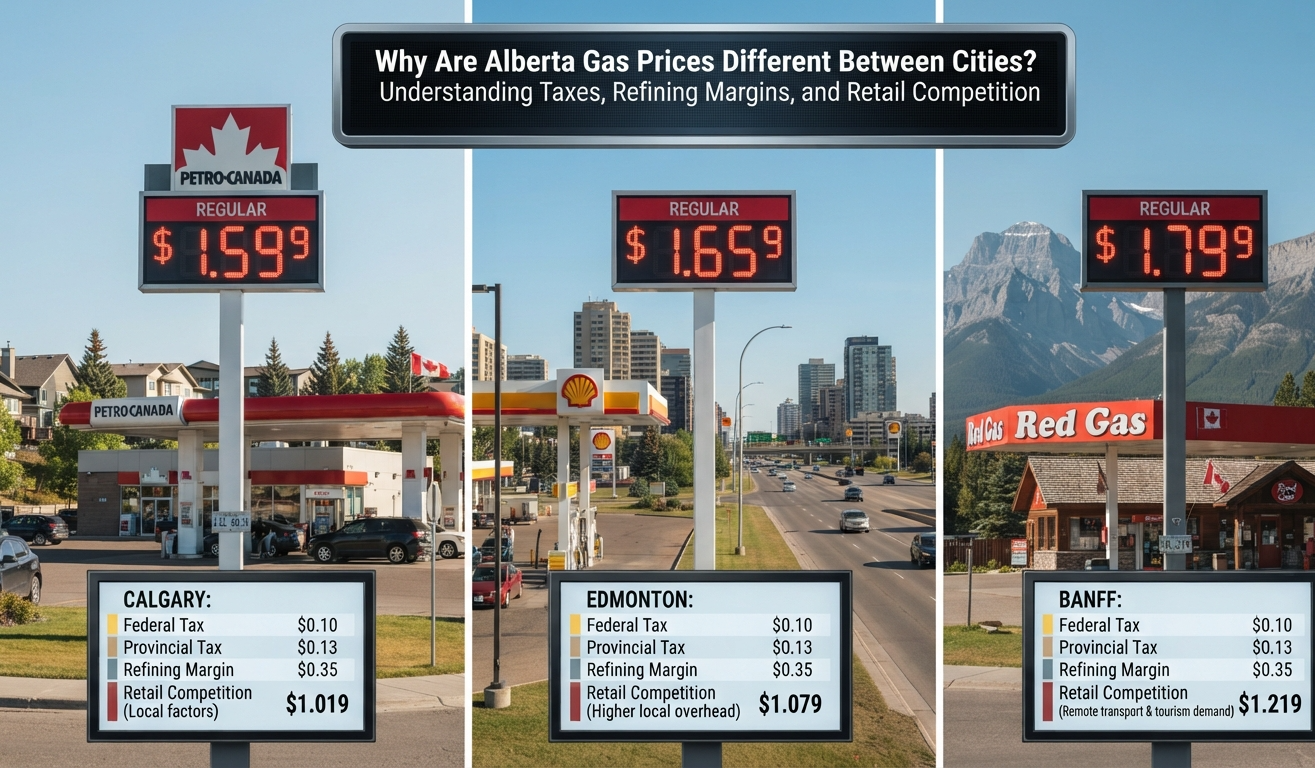
If you drive in Alberta, you have likely noticed a puzzling dynamic at the pump: gasoline prices can vary significantly not only between provinces, but even between neighboring cities like Calgary, Edmonton, Lethbridge, and Red Deer.
While Alberta consistently boasts some of the lowest average fuel prices in Canada due to its proximity to oil production and lower provincial tax structures, drivers often ask: Why does a litre of gasoline cost more in Calgary or Lethbridge than in Edmonton on the exact same day?
Understanding retail fuel pricing requires looking beyond raw crude oil headlines. Fuel prices are determined by a four-part pricing architecture: crude oil costs, refining margins, retail/marketing margins, and taxes.

Here is a detailed breakdown of how these components work together and why gas prices vary across Alberta.
1. The Four Cost Components of Alberta Gasoline
When you pay at an Alberta gas pump, your total price reflects four distinct financial layers:
- Crude Oil Benchmark (WTI & WCS): The underlying commodity cost. Oil prices fluctuate globally based on geopolitical factors, supply decisions by OPEC+, and North American refinery demand.
- Refining Margin (Wholesale Spread): The difference between the cost of unrefined crude oil and the wholesale price of refined gasoline. This covers the operating costs, technology, and profit margin of oil refineries.
- Retail Margin: The difference between the wholesale price paid by the gas station and the final pump price before taxes. This covers station operations, transportation, labor, and dealer profits.
- Taxes (Provincial, Federal & GST): Fixed and percentage-based government levies.
2. Proximity to Refineries: The Edmonton Advantage
One of the biggest factors causing regional price gaps inside Alberta is refinery location and transportation logistics.
The Edmonton region serves as Western Canada’s primary refining hub. Facilities such as the Strathcona Refinery (Imperial Oil), the Edmonton Refinery (Suncor), and the Shell Scotford complex are located in or directly adjacent to the Edmonton metropolitan area.
- Lower Transport Costs: Gas stations in Edmonton receive fuel via direct pipeline connections or short truck routes, minimizing distribution costs.
- Higher Freight Costs in Calgary & Southern Alberta: Cities like Calgary, Lethbridge, and Medicine Hat rely on fuel transported via secondary pipelines or long-haul fuel tankers. These extra transport and terminal-handling fees add direct costs per litre before the fuel even reaches local storage tanks.
3. Understanding Alberta’s Fuel Tax Structure
Taxes account for a stable, predictable portion of the pump price, but Alberta’s tax framework is unique compared to other Canadian provinces.
- Alberta Provincial Fuel Tax (Oil-Indexed): Unlike static provincial taxes in other provinces, Alberta employs a flexible fuel tax relief program. When West Texas Intermediate (WTI) crude trades above US$90 per barrel, the provincial tax is reduced or fully suspended. When WTI falls below US$80, the standard 13.0 cents per litre applies.
- Federal Excise Tax & GST: The federal government applies a standard excise tax alongside the 5% Goods and Services Tax (GST). Because GST is calculated on top of the fuel tax-inclusive price, it functions structurally as a tax on a tax.
Even with these levies, Alberta drivers pay substantially less tax per litre than motorists in British Columbia or Ontario, where higher provincial sales taxes (PST/HST) and regional transit surcharges (such as Vancouver’s TransLink levy) significantly inflate retail prices.
4. Local Retail Competition and Marketing Margins
Why can two gas stations on opposite sides of the same city charge different prices? The answer lies in retail margins and site economics.
Gasoline retailing is a high-volume, low-margin business. Station owners often make only a few cents per litre in net profit from fuel sales alone.
- Big-Box Retailers & Loss Leaders: Major hypermarket retailers (such as Costco or Superstore) use discounted fuel as a “loss-leader” strategy to drive foot traffic into their main retail stores. Independent stations located near big-box locations are forced to trim their retail margins to remain competitive.
- Convenience Store Revenue Subsidies: Modern gas stations with large convenience stores, car washes, or fast-food franchises can afford lower retail fuel margins because their operating costs are offset by higher-margin in-store sales.
- Traffic Density & Volume Sales: High-volume stations along major thoroughfares (such as Deerfoot Trail in Calgary or Gateway Boulevard in Edmonton) can operate profitably on smaller margins per litre due to total fuel turnover. Smaller neighborhood stations with lower traffic must maintain higher margins to cover fixed lease and utility costs.
5. Seasonal Gasoline Blending (Summer vs. Winter)
Seasonal price swings affect all Alberta cities simultaneously twice a year.
In the spring, refineries transition from winter-blend to summer-blend gasoline. Summer gasoline requires lower volatility additives (like alkylates instead of cheaper butane) to prevent evaporation in hot weather. Production of summer-blend fuel is more expensive and requires refinery maintenance downtime, temporarily tightening wholesale supply and raising refining margins.
In the autumn, refineries switch back to cheaper butane-blended winter fuel, which lowers wholesale costs.
Smart Fuel Strategies for Alberta Drivers
For Albertans looking to reduce household transportation costs, understanding these economic patterns yields practical advantage:
- Track Wholesale Cycle Days: Fuel prices in major urban centers often spike mid-week and settle lower on weekends or late evenings as stations compete for commuter volume.
- Utilize Wholesale Club Memberships: High-volume fuel outlets regularly trade at 5 to 10 cents per litre below traditional retail chains.
- Monitor Regional Spreads: If driving between Calgary and Edmonton, refueling in the Edmonton perimeter or Red Deer corridor often provides lower prices than inner-city Calgary stations.
Final Thoughts
Price variations across Alberta gas stations are not random. They reflect the complex intersection of distance from refineries, transport logistics, local market competition, and retail operating models.
At Maple Curiosity, we will continue monitoring energy infrastructure developments, provincial tax policy updates, and regional economic indicators across Western Canada.
Leave a Reply