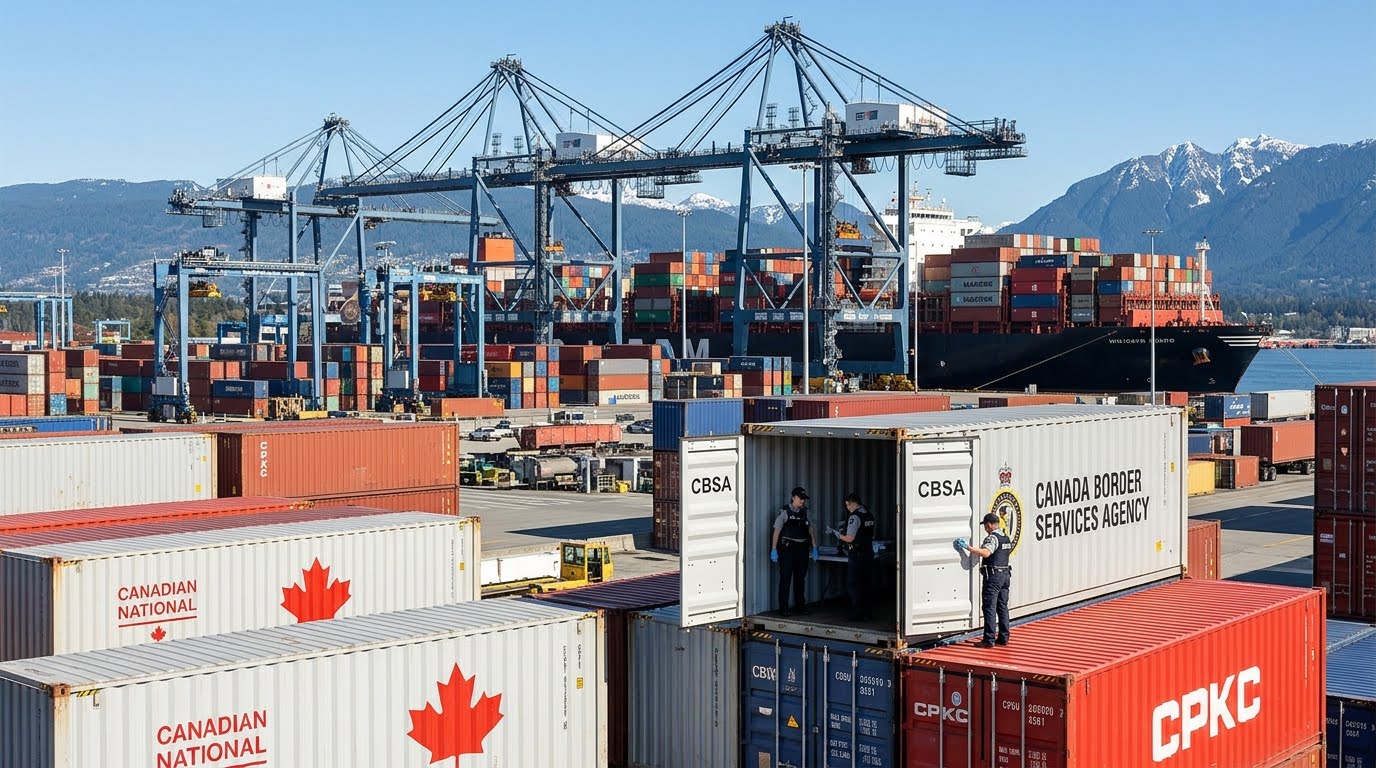
Canadian importers could eventually face significantly stronger requirements to prove where certain products come from and how they were produced.
On October 8, 2026, the federal government released two consultation reports on its proposed approach to forced labour in global supply chains, including Global Affairs Canada’s official report on Bill C-35.
The first focuses on Bill C-35, proposed legislation that would strengthen Canada’s existing ban on importing goods made with forced labour. The second examines a possible future system requiring some Canadian businesses to identify and address labour-rights risks throughout their international operations and supply chains.
The changes are not yet final. Bill C-35 remains before Parliament and could still be amended. No new list of prohibited products was created by the October 8 reports themselves.
Canada already bans goods made with forced labour
Canada’s forced-labour import prohibition is not new.
Since July 2020, the Customs Tariff has prohibited importing goods produced wholly or partly through forced labour.
The rule applies regardless of the country where the goods were produced.
Canada introduced the prohibition as part of its commitments under the Canada-United States-Mexico Agreement.
The challenge has been enforcement across complex global supply chains.
What would Bill C-35 change?
Bill C-35 was introduced in Parliament on June 12, 2026.
The proposed law would move Canada’s forced-labour import prohibition into a new standalone legislative framework.
One of the biggest changes would allow the Minister of Foreign Affairs to establish a public list of goods suspected of being produced with forced labour.
The list could identify a product together with a producer, country or region where there are reasonable grounds to suspect forced labour is involved.
Importers dealing in listed goods could then face new information requirements.
Importers may have to prove where products came from
Under the proposed system, an importer of a listed good could be required by the Canada Border Services Agency to provide prescribed information showing that the product is not linked to forced labour.
The exact documents and supply-chain information required would be established through regulations.
If an importer fails to provide the required information, Bill C-35 proposes that the goods could be deemed prohibited from importation.
That represents an important shift.
Instead of enforcement relying only on government authorities proving a particular shipment was produced with forced labour, importers of listed goods could have a more direct obligation to provide evidence about their supply chains.
Bill C-35 is not in force yet
This point is important for Canadian businesses.
The October consultation reports do not create a new import requirement today.
Bill C-35 is still before Parliament.
The final wording could change during the legislative process, and detailed importer requirements would also depend on future regulations.
Businesses should therefore distinguish between Canada’s existing forced-labour prohibition and the additional system proposed under Bill C-35.
What did businesses say during the consultation?
Global Affairs Canada and the Canada Border Services Agency collected feedback through stakeholder roundtables and written submissions.
Businesses broadly supported clearer enforcement rules but raised practical concerns about tracing products through complicated supply chains.
Many importers know their immediate supplier.
They may have far less information about the factories, processors, mines, farms or subcontractors several levels further upstream.
Industry participants said obtaining reliable information beyond direct suppliers can be expensive and difficult, especially when suppliers change frequently or commercial information is confidential.
Companies want predictable rules
Stakeholders repeatedly called for a risk-based and transparent system.
Businesses asked the government to provide clear guidance on:
- how goods would be added to the forced-labour list
- what evidence importers would need to provide
- how importers could challenge or correct a decision
- how Canadian requirements would align with rules in the United States and European Union
International alignment matters because a Canadian importer may operate the same supply chain used for U.S. or European customers.
Different evidence requirements in each market could increase compliance costs considerably.
Changing suppliers may not be enough
The consultation also revealed a difference in emphasis between industry participants and labour or civil-society groups.
Businesses highlighted the difficulty of finding alternative suppliers when supply chains are concentrated.
Labour and civil-society participants argued that simply dropping a supplier does not necessarily solve the underlying exploitation.
They called for companies to use commercial leverage where possible to improve conditions and provide remedies to affected workers.
The final government approach will need to balance effective enforcement with the risk that abrupt supplier changes can move, rather than eliminate, labour exploitation.
A second proposal could go beyond imports
The October 8 release also included a separate consultation on possible corporate due-diligence requirements.
This proposal is broader than Bill C-35.
It could require certain Canadian businesses operating internationally to identify, prevent, address and remediate risks to fundamental labour rights throughout their operations and supply chains.
The government also asked for feedback on possible civil liability.
Under such a system, victims of labour exploitation could potentially seek damages in Canadian courts against a business that failed to carry out required due diligence.
No final due-diligence law has been enacted through this consultation.
Which companies could eventually be affected?
The consultation considered several possible approaches.
One option discussed applying future due-diligence obligations to Canadian businesses operating abroad that have at least $40 million in worldwide annual revenue or an average of at least 250 employees worldwide.
Other options would target only larger businesses or allow sector-specific rules.
These were consultation options, not finalized thresholds.
Canada already has a supply-chain reporting law
A separate law is already in effect.
The Fighting Against Forced Labour and Child Labour in Supply Chains Act took effect on January 1, 2024.
It requires certain businesses and federal institutions to report publicly on steps taken to prevent and reduce forced labour and child labour in their supply chains.
This is primarily a transparency and reporting regime.
Bill C-35 would address the separate issue of whether goods can enter Canada.
Which businesses currently have reporting obligations?
Under the current Supply Chains Act, an organization can fall within the definition of an entity if it is listed on a Canadian stock exchange.
Other organizations doing business in Canada, having a place of business here or holding assets here can also qualify if they meet at least two of three size tests for at least one of their two most recent financial years:
- at least $20 million in assets
- at least $40 million in revenue
- an average of at least 250 employees
An entity generally has a reporting obligation only if it produces goods, imports goods or controls another entity that produces or imports goods.
The annual reporting deadline is May 31.
Public Safety Canada’s current portal remains open for businesses submitting late or revised 2026 reports.
Why this matters to retailers and importers
The impact could extend far beyond companies normally thought of as manufacturing businesses.
Canadian retailers can sell products manufactured through long international supply chains.
Importers may source apparel, electronics, food, minerals, industrial equipment or other goods through overseas suppliers.
If a product category or producer appears on a future Bill C-35 list, the importer may need detailed information from suppliers before the goods can clear Canadian requirements.
That could make supplier traceability an increasingly important part of purchasing decisions.
Small businesses are not automatically covered by every rule
It would be incorrect to say every Canadian small business will suddenly need to file a supply-chain report.
The current Supply Chains Act has specific entity and activity tests.
The possible future due-diligence system also remains under development.
However, smaller companies can still be indirectly affected.
A large importer may ask its smaller suppliers for additional origin documents, factory information or contractual assurances so it can satisfy its own compliance obligations.
Critical minerals are one sector where traceability matters
The government’s consultation included stakeholders from the mining and minerals industry.
That is significant because critical-mineral supply chains can involve extraction, processing and manufacturing across multiple countries.
Canada is simultaneously trying to expand domestic critical-mineral production and reduce dependence on vulnerable international supply chains.
Maple Curiosity’s Canada Critical Minerals 2026 analysis looks at the industry’s $26.3 billion GDP contribution and nearly 57,500 jobs.
Trade policy is increasingly about supply chains, not just tariffs
Canadian trade discussions are often dominated by tariff rates.
Bill C-35 illustrates another type of trade barrier: whether a product can enter the country at all and what evidence the importer must produce.
For businesses, that can make supply-chain documentation almost as important as the tariff applied at the border.
Maple Curiosity’s Canada–U.S. Trade Friction 2026 analysis explains the wider tariff, CUSMA and supply-chain environment.
This is also a competitiveness issue
The federal government argues that goods made using forced labour create unfair competition because exploitation can artificially reduce production costs.
From that perspective, stricter import enforcement is intended both to protect human rights and to create a more level playing field for businesses that follow higher labour standards.
But stronger documentation rules also have costs.
That is why business groups emphasized predictable requirements and alignment with Canada’s major trading partners.
How does this fit with Canada’s broader red-tape agenda?
The timing creates an interesting policy tension.
Canada recently introduced Bill S-7 with the goal of reducing unnecessary federal regulatory burden in several sectors.
At the same time, forced-labour rules could increase documentation requirements for some importers.
The objectives are different: one seeks to simplify outdated regulation, while the other seeks to strengthen supply-chain enforcement.
Maple Curiosity’s Bill S-7 analysis explains the separate federal red-tape proposal.
What should Canadian importers do now?
Businesses should not treat the October consultation report as if Bill C-35 were already law.
But companies that depend heavily on imported products can use the proposal as a warning about the direction of Canadian compliance requirements.
Importers can review how well they currently know their suppliers, whether they can trace goods beyond the first tier and what documentation they could produce if customs authorities asked where a product originated.
Large organizations already subject to the Supply Chains Act should also make sure their existing reporting obligations are being met.
What happens next?
Parliament must continue considering Bill C-35.
If the legislation passes, regulations would still be needed to determine important details such as the information importers of listed goods must provide.
The government is also considering what, if anything, to do with the separate due-diligence and civil-liability proposal.
For now, no new product should be described as prohibited solely because of the October 8 consultation reports.
The important development is that Canada’s approach may be shifting from broad supply-chain transparency toward more targeted proof requirements at the border.
Leave a Reply