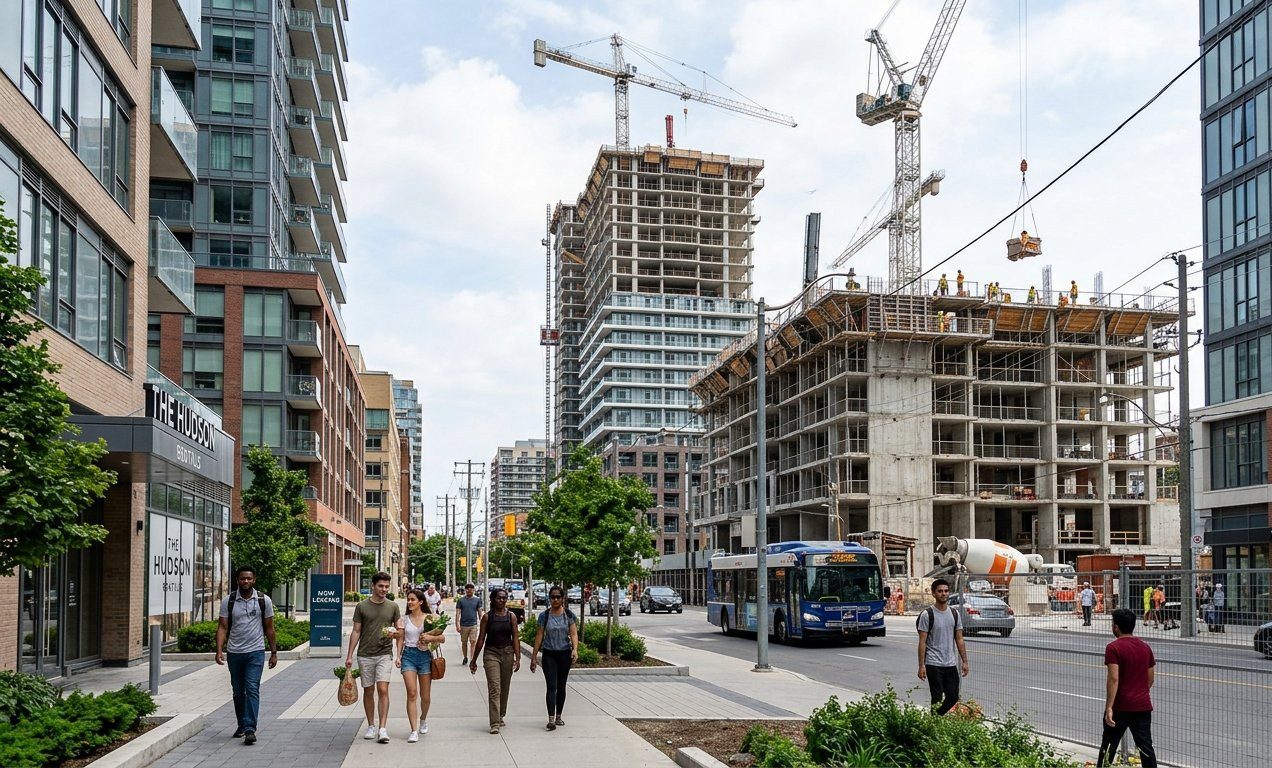
Canada is building purpose-built rental housing at record levels, but that does not mean Canada’s rental affordability problem has been solved.
New results from CMHC’s 2026 Canadian Rental Housing Development Survey show a market with two very different stories happening at the same time.
Rental construction is at an all-time high and developers remain confident that Canada will need rental housing over the long term. But approval delays, government fees, construction costs and uncertain market conditions are still making new projects difficult to launch.
CMHC also says much of the new rental supply is concentrated in higher-priced units, which helps explain why more construction does not immediately translate into affordable rents for every household.
Canada’s 2026 Rental Construction Picture at a Glance
| CMHC Finding | What It Means |
|---|---|
| Purpose-built rental construction | At an all-time high |
| Long-term developer outlook | More than half remain optimistic about long-term rental development |
| Main barriers | Approval delays, regulations, fees, construction costs and market conditions |
| Financing | Only about 10% reported increased financing challenges |
| Modern construction methods | Used by roughly 45% of respondents, up sharply from about one-fifth previously |
| Vacancy rates | Rising in some markets |
| Rent growth | Slowing in parts of Canada |
| Affordability | Still a challenge, with new supply concentrated in higher-priced units |
Record Construction Does Not Automatically Mean Affordable Rent
More rental construction increases housing supply, which can reduce pressure on a tight market over time.
But supply has to be considered alongside what is being built and what households can afford.
CMHC says new rental supply is concentrated in higher-rent units.
That makes sense from a development perspective because a newly constructed building has to absorb today’s land, labour, financing and construction costs.
The result is that a city can add thousands of new apartments and still have a serious affordability problem for lower-income renters.
Developers Still Expect Strong Long-Term Rental Demand
More than half of respondents to CMHC’s 2026 survey remain optimistic about the long-term feasibility of rental development.
That confidence matters because purpose-built rental projects are normally held and operated over many years rather than being sold immediately like individual condominium units.
Developers are increasingly using a develop-and-hold strategy, meaning the owner builds the rental property and keeps it as a long-term income-producing asset.
That is different from a model where the goal is to build, sell and move quickly to the next project.
Approval Delays and Fees Remain Major Barriers
According to CMHC’s 2026 Rental Housing Development Survey analysis, the biggest problems are not simply whether a developer can obtain a loan.
Respondents continue to identify:
- government regulations
- approval delays
- development fees
- elevated construction costs
- uncertain market conditions
Only around 10% of firms reported increased financing challenges.
CMHC’s conclusion is that the bigger issue for many projects is whether they remain financially viable after all of the costs and delays are included.
Why Project Viability Matters
A proposed apartment building can have strong future rental demand and still fail to move forward.
A developer has to compare the expected rent and long-term value of the property with:
- land acquisition costs
- construction costs
- municipal fees
- approval time
- financing costs
- operating costs
- expected vacancy
If those numbers do not work, construction may be postponed even in a city that needs more housing.
This helps explain why a shortage of housing cannot always be solved simply by identifying demand.
Rental Builders Are Using More Prefabrication and Modern Construction
One of the more notable changes in the 2026 survey is the increase in modern construction methods.
CMHC says adoption rose from roughly one-fifth of respondents previously to around 45% this year.
Many developers are starting with components that can be prefabricated rather than immediately switching an entire project to fully modular construction.
The idea is to reduce construction time or improve productivity without completely changing established building processes.
Longer Amortizations Can Improve Project Cash Flow
CMHC also says more developers are considering longer amortization periods.
Stretching financing over a longer period can reduce scheduled debt payments and improve cash flow during the operating years of a rental property.
That does not reduce the underlying construction cost, but it can change the financial feasibility of a project.
This is one reason housing financing programs can affect how many rental projects are able to proceed even when financing itself is not the industry’s largest current barrier.
Vacancies Are Beginning to Rise in Some Markets
Canada’s rental market is no longer moving in exactly the same direction everywhere.
CMHC reports that rental conditions are easing somewhat in parts of the country as new purpose-built supply becomes available.
That includes:
- higher vacancy rates in some markets
- slower rent growth
- large volumes of recently completed apartments
For renters, slower rent growth can be helpful even when rents do not actually decline.
But the effect varies greatly by city, neighbourhood and unit type.
Edmonton Shows How More Supply Can Change a Market
Edmonton is particularly useful as a case study because the city has recently experienced unusually strong homebuilding.
CMHC’s Fall 2026 Housing Supply Report says Edmonton remains one of Canada’s more affordable major housing markets and currently shows no measurable housing supply gap under CMHC’s affordability-restoration framework.
That does not mean housing is affordable for everyone.
CMHC specifically notes that lower-income Edmonton households continue to have difficulty finding housing they can afford.
Edmonton Housing Starts Slowed After Record Building
Edmonton’s housing market is also transitioning from rapid project launches toward completion of projects that were already under construction.
According to CMHC:
- housing starts in Edmonton fell about 20% in the first half of 2026 compared with 2025
- apartment completions increased about 30%
- the number of homes under construction reached a record of roughly 17,900
That means a slowdown in new starts does not immediately mean less housing is arriving in the market.
Large numbers of projects started during the earlier construction boom are still being completed.
Maple Curiosity’s Canada Housing Starts August 2026 analysis looks at the more recent movement in Calgary and Edmonton starts.
Why Renters May Not Feel the Full Benefit Immediately
There can be a considerable delay between a new building permit, construction start and an apartment becoming available to rent.
Even after completion, new buildings often enter the market at relatively high rents because they are carrying the cost of new construction.
Additional supply can still affect the wider market by giving tenants more alternatives and increasing competition between landlords.
But this process is gradual rather than immediate.
New Rental Supply and Affordable Housing Are Different Problems
Canada needs both more rental supply and housing that lower-income households can afford.
Those objectives overlap, but they are not identical.
Market-rate construction adds units to the overall system.
Affordable and community housing programs target households that may not be able to afford newly built market rents even in a city with adequate overall supply.
This distinction is also why Canada has programs designed to preserve existing lower-cost rental buildings rather than relying only on new construction.
Maple Curiosity’s Canada Rental Protection Fund guide explains the separate $1.5-billion program aimed at protecting existing affordable rental housing.
What This Means for Someone Renting in Alberta
For a renter, national construction records matter less than conditions in the specific city and neighbourhood where they are looking for housing.
Edmonton currently has a relatively strong supply position compared with several other major Canadian markets.
That can create more choice, especially when a large number of recently completed apartments enter the market.
However, lower-income households can still face affordability pressure even when vacancy rates rise.
Anyone budgeting for a move should therefore compare actual rents, utilities, transportation and insurance rather than assuming a high construction rate automatically means cheap housing.
Maple Curiosity’s Alberta Cost of Living 2026 guide breaks down those broader household expenses.
What Prospective Renters Should Watch Next
Several indicators will show whether record rental construction is translating into a meaningfully easier market for tenants:
- vacancy rates
- average and median rents
- rent growth on turnover units
- number of apartment completions
- new rental construction starts
- how much new supply is affordable to lower-income households
One month of construction data is not enough to answer all of those questions.
The more useful picture comes from following starts, completions, vacancy rates and rents together.
More Housing Is Arriving, but the Affordability Question Remains
CMHC’s 2026 survey shows that Canada’s rental-development industry has not lost confidence in the need for apartments.
Construction is at record levels and developers continue to expect strong long-term demand.
The harder problem is making enough projects financially viable while delivering units at rents households can actually afford.
Approval times, municipal fees and construction costs therefore matter to renters even though those costs are largely invisible when someone searches for an apartment.
For people comparing Alberta with a more expensive housing market, Maple Curiosity’s Edmonton vs Vancouver 2026 guide provides a broader cost-of-living comparison.
Leave a Reply