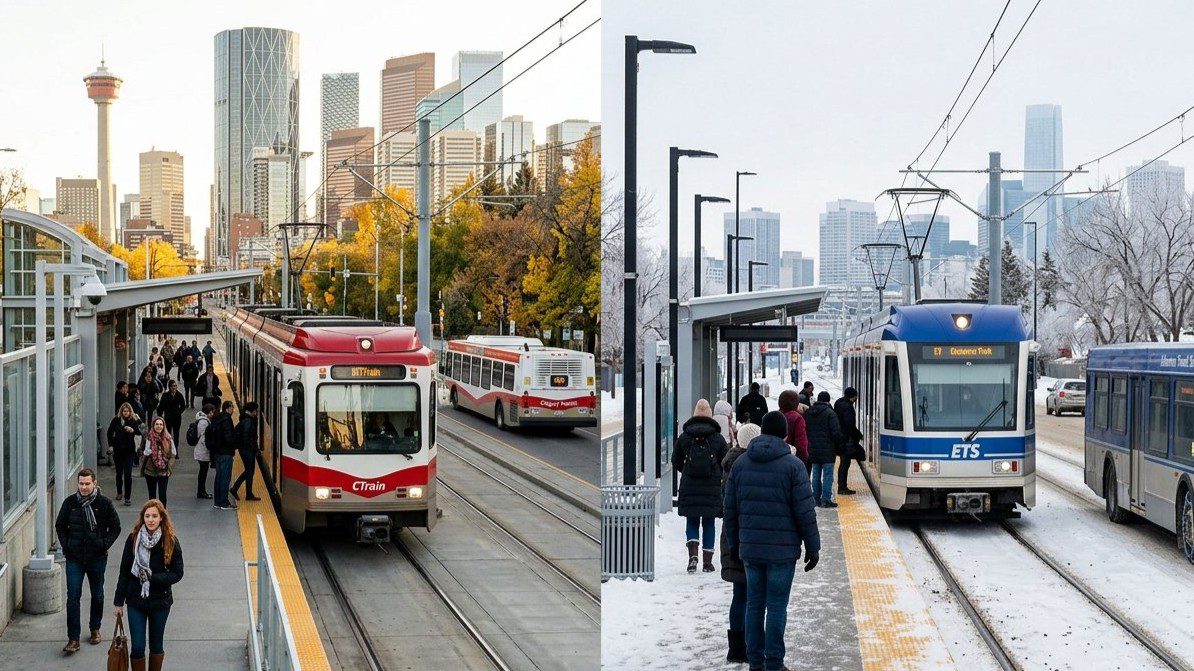
Calgary and Edmonton both operate extensive public transit systems built around buses and light rail, but the way riders pay fares and use the networks is different.
Calgary Transit operates the CTrain and bus network, while Edmonton Transit Service, commonly called ETS, operates buses, LRT and On Demand Transit.
For newcomers, students and workers, understanding the fare system before the first trip can prevent unnecessary costs and make commuting easier.
This guide compares Calgary Transit and Edmonton ETS using current 2026 fares, rail networks, mobile payment options and practical trip-planning information.
If you are deciding which Alberta city better fits your household, see our Calgary vs Edmonton Cost of Living 2026 guide.
Calgary Transit vs Edmonton ETS: 2026 Quick Comparison
| Transit Feature | Calgary | Edmonton |
|---|---|---|
| Main rail system | CTrain Red and Blue lines | Capital, Metro and Valley LRT lines |
| Adult pay-as-you-go fare | $4.00 single ride | $3.00 with Arc or eligible credit/debit tap |
| Adult monthly cost | $126 monthly pass | $102 Arc monthly fare cap |
| Adult day option | $12.65 day pass | $10.50 Arc daily fare cap |
| Mobile fare option | My Fare and Transit apps | Arc plus physical or digital credit/debit payment |
| Downtown free rail area | Yes, along the designated 7 Avenue Free Fare Zone | No comparable downtown free LRT zone |
Fare rules and service can change, so riders should check the applicable transit agency before travelling.
Calgary Transit: Understanding the CTrain and Bus Network
Calgary Transit combines the CTrain light rail system with local buses, express services and MAX rapid-bus routes.
The CTrain is particularly important for travel between downtown Calgary and communities connected to the Red and Blue lines.
Current rail and bus maps are available through the official Calgary Transit system maps.
Not every Calgary neighbourhood is within walking distance of a CTrain station.
Many households use a bus to reach a CTrain station or drive to a Park and Ride facility before continuing by rail.
When comparing neighbourhoods, check the complete trip rather than simply measuring the distance to downtown.
Calgary’s Downtown Free Fare Zone
One of Calgary Transit’s most distinctive features is the downtown CTrain Free Fare Zone.
In 2026, passengers can continue riding without paying a fare when their entire CTrain trip begins and ends within the designated section of 7 Avenue between Downtown West/Kerby and City Hall/Bow Valley College.
The Free Fare Zone does not mean every CTrain trip into downtown is free.
If your journey begins outside the zone or continues outside it, a valid fare is required.
Calgary reviewed the future of the Free Fare Zone in 2026, but City Council deferred a decision until the broader transit fare strategy is considered in 2027.
Current information is available from Calgary Transit’s Free Fare Zone information page.
Calgary Transit Fares in 2026
Calgary Transit increased several fares for 2026.
| Fare Type | 2026 Price |
|---|---|
| Adult single ride | $4.00 |
| Youth single ride | $2.65 |
| Adult day pass | $12.65 |
| Youth day pass | $9.25 |
| Adult monthly pass | $126.00 |
| Youth monthly pass | $92.00 |
| Weekend group/family day pass | $18.00 |
Children aged 12 and under ride Calgary Transit free.
Single fares are valid for 90 minutes, allowing riders to transfer between eligible buses and CTrain services during the validity period.
See the latest prices on the official Calgary Transit fares and passes page.
Using the Calgary My Fare App
Calgary’s My Fare app allows passengers to purchase and store eligible transit tickets and passes on a smartphone.
Calgary Transit also supports fare purchases through the Transit app.
Mobile riders should pay attention to fare validation.
For a CTrain trip, a mobile ticket must be activated and then scanned at a platform validator before boarding.
On a bus, the activated mobile ticket or pass is scanned using the onboard validator.
A ticket stored on the phone but not properly activated and validated is not the same as valid proof of payment.
Instructions are available on the official Calgary Transit My Fare page.
Planning a Calgary Transit Trip
Calgary Transit recommends the Transit app as one of its rider tools for journey planning and real-time information.
It can help riders compare routes, transfers and estimated arrivals before leaving home.
See Calgary Transit’s current Rider Tools for available trip-planning options.
This can be particularly useful during winter, when spending an extra 10 or 15 minutes waiting outside can make a significant difference to the trip.
Edmonton Transit Service: Buses, LRT and On Demand Transit
Edmonton Transit Service operates a network of conventional buses, LRT lines, transit centres and On Demand Transit.
The city’s current LRT network includes the Capital Line, Metro Line and Valley Line.
The Capital Line connects major destinations through the city, including downtown, the University of Alberta area and south Edmonton.
The Metro Line operates between NAIT/Blatchford Market and Health Sciences/Jubilee.
The Valley Line connects Mill Woods in southeast Edmonton with 102 Street downtown.
Current station information and service frequencies are available from the City of Edmonton LRT Stops and Stations page.
Edmonton Arc: How the Fare System Works
Edmonton uses the Arc electronic fare system.
Arc allows riders to load money onto an Arc card and pay as they travel rather than requiring everyone to purchase a monthly pass in advance.
The system also supports fare capping.
For regular adult ETS travel in 2026, the main fares are:
| Fare Type | 2026 Price |
|---|---|
| Arc pay-as-you-go 90-minute fare | $3.00 |
| Adult Arc daily fare cap | $10.50 |
| Adult Arc monthly fare cap | $102.00 |
| 90-minute Arc ticket | $3.75 |
| 24-hour Arc ticket | $10.50 |
| Cash fare | $3.75 |
Current fares are listed on the City of Edmonton ETS fares page.
How Edmonton’s Arc Fare Cap Can Save Money
Fare capping means an eligible rider does not need to decide at the beginning of the month whether a monthly pass will be worthwhile.
Instead, qualifying Arc trips accumulate toward the applicable fare cap.
For a regular adult travelling within Edmonton, the 2026 monthly ETS fare cap is $102.
Once the rider reaches the applicable monthly cap, additional qualifying ETS travel for the remainder of that month does not add another regular local fare.
There is also a daily cap of $10.50 for regular adult travel.
This can be useful for riders whose transit use changes from week to week.
More information is available on the official Arc fare-capping guide.
Remember to Tap On and Tap Off With Arc
Arc differs from many traditional transit payment systems because riders should tap both when entering and when completing a trip.
On Edmonton buses, tap when boarding and tap again when leaving.
For LRT trips, tap at an Arc validator before entering the system and tap again when the trip is complete.
The Arc system uses the starting and ending points to calculate the appropriate fare.
Failing to tap off can result in a missing-tap fare.
Riders should therefore make tapping off part of their normal routine.
Can You Use a Credit or Debit Card on Edmonton Transit?
ETS accepts eligible physical and digital credit or debit cards for pay-as-you-go travel.
For regular Edmonton travel, the current adult tap fare is $3 for a 90-minute trip.
Use the same payment card or device consistently when tapping so the system can correctly track the trip and applicable fare treatment.
Do not tap in with a physical credit card and tap out with the same card stored in a digital wallet, because the payment system can treat those as different credentials.
For the latest payment options, check the ETS fares and passes page.
Edmonton Transit for Children and Youth
Children aged 12 and under can ride ETS free when accompanied by a fare-paying rider.
A child aged 12 or under travelling without an accompanying fare-paying rider must use an appropriate fare.
Youth riders aged 18 and under have access to youth fare products, including a lower monthly Arc cap than the standard adult cap.
Families should check the current ETS youth fare information before purchasing a pass or loading an Arc account.
Edmonton On Demand Transit
Not every Edmonton neighbourhood has conventional fixed-route bus service immediately nearby.
ETS operates On Demand Transit for selected neighbourhoods, seniors’ residences and attractions.
Eligible trips are booked before boarding and connect riders with designated transit hubs or destinations.
Bookings can be made through the Edmonton On Demand Transit app, online or through the call centre.
Coverage changes as Edmonton adjusts conventional bus service, so riders should verify whether a particular neighbourhood is currently included.
See the current Edmonton On Demand Transit information.
How to Track Edmonton Buses in Real Time
ETS provides official trip-planning tools with schedules, routes, alerts and real-time bus information.
Riders can also use ETS Text & Ride by texting a bus stop number to 31100 for upcoming departure information.
Third-party tools such as Transit and Google Maps can also be useful, but checking the official ETS trip planner is helpful when service or routing has recently changed.
Current tools are available through the ETS Trip Tools page.
Calgary vs Edmonton Transit Costs for a Regular Adult Rider
The two cities use different fare structures, so the headline monthly price does not tell the entire story.
| Example | Calgary | Edmonton |
|---|---|---|
| Single adult trip | $4.00 | $3.00 with Arc or eligible card tap |
| Adult day option | $12.65 day pass | $10.50 Arc daily cap |
| Regular adult monthly maximum/pass | $126 monthly pass | $102 Arc monthly cap |
Calgary’s monthly pass is purchased for the calendar month and provides unlimited eligible Calgary Transit travel during that period.
Edmonton’s regular Arc system works differently: riders pay as they travel until reaching the applicable fare cap.
That distinction can matter for people who work from home, use transit only several days per week or alternate between driving and transit.
Which City Is Easier Without a Car?
Whether a household can comfortably live without a vehicle depends more on the exact home and workplace than on the city name alone.
A Calgary property near a CTrain station can provide a very different commute from a home in an outer community requiring multiple bus transfers.
The same applies in Edmonton.
A home near the Capital, Metro or Valley LRT lines or a frequent bus corridor may allow practical daily transit use, while some outer neighbourhoods can be considerably easier with a vehicle.
Before choosing housing, calculate the actual weekday trip between:
- home and work
- home and school
- home and childcare
- home and grocery stores
- home and medical appointments
- home and major recreation activities
For a closer look at neighbourhood location and transit access, see our Calgary vs Edmonton Neighbourhood Guide 2026.
Public Transit in Alberta During Winter
Winter changes the practical experience of taking transit in both cities.
A route that feels easy in September can be more difficult during snow, wind and periods of extreme cold.
Before leaving home in winter:
- check real-time departure information
- review service alerts
- allow extra transfer time
- wear insulated footwear and outerwear
- know where the nearest indoor waiting location is
- keep your phone charged
- have your fare ready before the vehicle arrives
Real-time information is especially useful because it can reduce unnecessary time waiting outdoors.
Do Not Rely Only on Google Maps Before an Important Trip
Google Maps and other third-party applications can be convenient for general trip planning.
However, transit agencies can publish detours, route changes and service alerts that may not appear immediately in every third-party application.
For an airport trip, job interview, medical appointment or other time-sensitive journey, check the official transit agency information before leaving.
Use Calgary Transit for Calgary and Edmonton Transit Service for Edmonton.
Airport Transit Is Different From Regular City Travel
Both cities provide public transit connections to their airports, but airport routes should be checked separately from ordinary city trips.
In Edmonton, Route 747 connects Century Park Transit Centre with Edmonton International Airport.
As of February 2026, the Route 747 fare is $6 per one-way airport trip, with separate airport fare-cap rules.
See the current ETS Edmonton International Airport service information.
Calgary also provides airport express service between Calgary International Airport and the city transit network.
Because Calgary Transit changed and renumbered several routes in fall 2026, airport travellers should verify the current route number and schedule immediately before travelling through the official Calgary Transit trip planner.
Calgary or Edmonton Transit: What Newcomers Should Check Before Choosing Housing
Public transit can change the real cost of a neighbourhood.
A less expensive rental may not produce a lower household budget if it requires purchasing and operating a second vehicle.
Before signing a lease, check:
- The complete transit trip to work or school
- Number of transfers required
- Early-morning and late-evening service
- Weekend frequency
- Walking distance to the stop or station
- Availability of shelters or indoor waiting areas
- Monthly transit cost
- Whether one household vehicle is still required
- Winter walking conditions
- Airport access if frequent travel is expected
For families planning a temporary stay, our Edmonton vs Vancouver 1-Year Stay Guide 2026 also compares transportation with housing and school costs.
Frequently Asked Questions
How much is Calgary Transit in 2026?
The regular adult single fare is $4, the adult day pass is $12.65 and the adult monthly pass is $126.
Children aged 12 and under ride free.
How much is Edmonton Transit in 2026?
A regular adult Arc pay-as-you-go trip within Edmonton costs $3 for 90 minutes.
The regular adult Arc daily cap is $10.50 and the monthly fare cap is $102.
Cash and a 90-minute Arc ticket cost $3.75.
Is the Calgary CTrain free downtown?
Yes, but only for trips that begin and end entirely within Calgary’s designated 7 Avenue Free Fare Zone between Downtown West/Kerby and City Hall/Bow Valley College.
A fare is required when travelling beyond the Free Fare Zone.
Do I have to tap off Edmonton Transit?
Arc users should tap on and tap off buses and LRT trips so the system can correctly calculate the fare.
Failing to tap off can result in a missing-tap fare.
Can I pay for Edmonton Transit with a credit card?
ETS accepts eligible physical and digital credit or debit cards for tap payment.
Use the same card or payment device for the complete trip.
Does Calgary use the Arc card?
No.
Arc is used in the Edmonton regional transit system. Calgary uses its own fare products, including paper or machine-issued tickets, passes, the My Fare app and fare products available through the Transit app.
Which city has the cheaper adult monthly transit option in 2026?
Calgary’s regular adult monthly pass costs $126.
Edmonton’s regular adult Arc monthly fare cap is $102.
The systems work differently because Calgary sells a monthly pass while Edmonton Arc riders accumulate eligible fares until reaching the monthly cap.
Can I use public transit during an Alberta winter?
Yes, both Calgary and Edmonton operate transit year-round.
During severe winter weather, riders should check real-time departures and official service alerts before leaving and allow additional time for delays or transfers.
Conclusion
Calgary and Edmonton both provide large bus and light rail networks, but their fare systems differ significantly.
Calgary combines its CTrain and bus network with mobile ticketing, a traditional monthly pass and a downtown Free Fare Zone.
Edmonton uses the Arc system with pay-as-you-go fares and daily and monthly fare caps, alongside the Capital, Metro and Valley LRT lines.
For someone choosing where to live, the most important question is not simply which city has the cheaper transit fare.
Check the exact route from home to work or school, the number of transfers, evening and weekend service, winter walking distance and whether the household can realistically reduce car use.
Those factors determine how useful public transit will be in everyday life.
Disclaimer: Transit fares, routes, schedules, payment systems and service levels can change. Confirm current information directly with Calgary Transit, Edmonton Transit Service and Arc before travelling or making a housing decision.
Leave a Reply