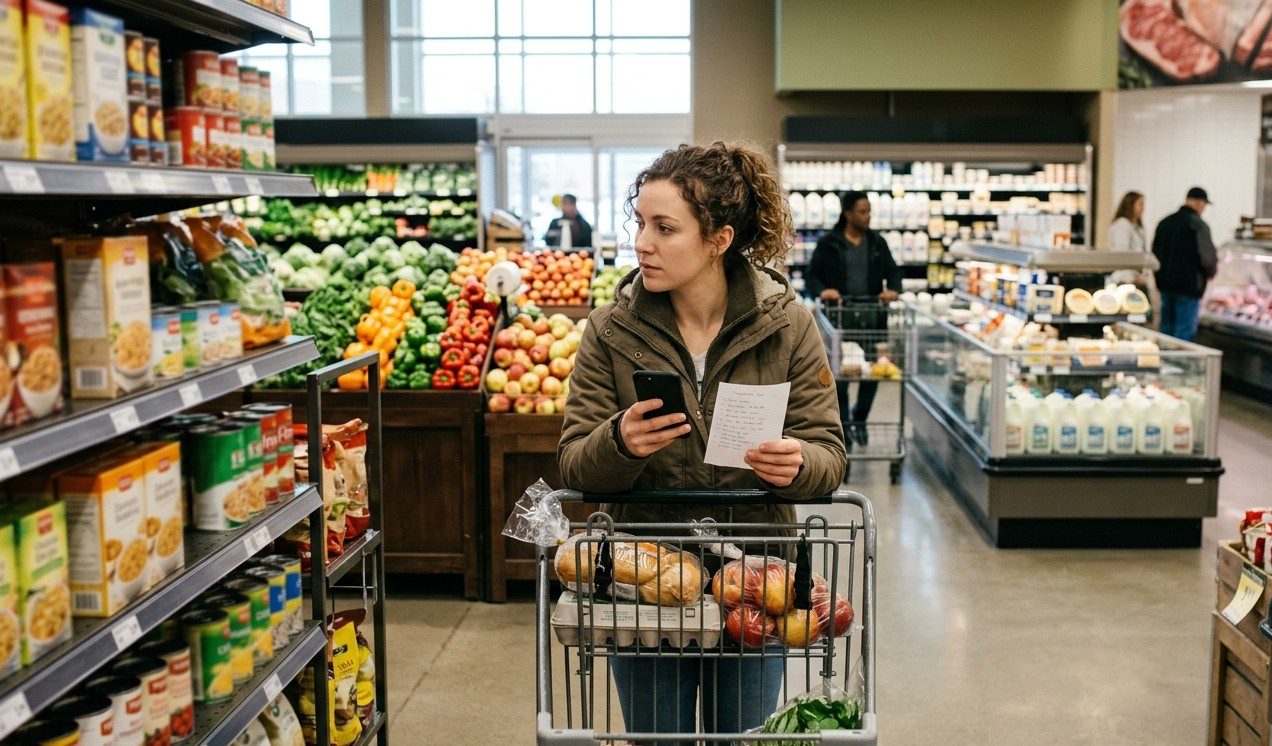
If your grocery bill still feels high in Alberta, the latest inflation numbers can seem confusing. Grocery inflation has slowed, but prices are still far above where they were a few years ago.
Statistics Canada reported that prices for food purchased from stores were 2.8% higher in August 2026 than a year earlier. That was down from 3.1% in July and marked the first time since July 2024 that grocery-price growth was slower than Canada’s overall inflation rate.
At the same time, grocery prices were still 29.0% higher than in August 2021. That longer-term increase is why a lower inflation rate does not necessarily translate into a noticeably cheaper grocery trip.
The latest national CPI release is available from Statistics Canada.
Grocery Inflation Is Slowing, but Prices Are Not Falling Back to 2021 Levels
An inflation rate of 2.8% means grocery prices were still increasing compared with the same month a year earlier. It does not mean prices fell by 2.8%.
That distinction matters. A household can see slower price growth and still feel pressure because the starting price is already much higher than it was several years ago.
Statistics Canada also showed that different food categories moved at different rates in August 2026. Fresh fruit was up 4.7% year over year, fresh or frozen pork was up 1.6%, and dairy-product inflation slowed to 0.7%.
So two Alberta households can experience grocery inflation very differently depending on what they regularly buy.
Current Grocery Price Benchmarks
Statistics Canada publishes monthly average retail prices for selected food products. These figures are useful as benchmarks, but they are not guaranteed shelf prices for Alberta stores.
For July 2026, the national average prices included:
| Product | Canada Average, August 2026 |
|---|---|
| Milk, 2 litres | $5.49 |
| White bread, 675 g | $3.63 |
| White rice, 2 kg | $9.73 |
| Butter, 454 g | $5.68 |
| Ground beef, 1 kg | $16.75 |
| Chicken breasts, 1 kg | $14.41 |
| Eggs, 1 dozen | $4.83 |
| Apples, 1 kg | $6.47 |
| Bananas, 1 kg | $1.89 |
| Potatoes, 1 kg | $5.17 |
| Tomatoes, 1 kg | $4.80 |
Statistics Canada released these August retail-price averages on October 7. Compared with July, some staples moved in opposite directions: ground beef and rice were higher, while butter, chicken breasts, eggs and tomatoes were lower. These are national transaction-based averages rather than a promise of what any one Alberta store will charge, so local flyer prices and package sizes can still differ.
For current national and provincial comparisons, see Statistics Canada’s Food Price Data Hub.
Statistics Canada cautions that average retail prices can differ because of brand, package size, quality, promotions and geography. Provincial figures, including Alberta, are available through its monthly retail-price table and Food Price Data Hub.
Why Alberta Grocery Bills Can Differ So Much
There is no single monthly grocery number that fits every Alberta household.
Spending changes with household size, dietary needs, how much meat or prepared food is purchased, how often meals are cooked at home, and how much food is wasted.
Location matters too. Statistics Canada’s provincial retail-price data can show different average prices across provinces, and the agency warns that geographic comparisons should be made carefully because brands and package sizes are not always identical.
That is why a generic online claim such as “one person in Alberta spends exactly $400 a month on groceries” should be treated as an estimate rather than an official benchmark.
Alberta Has No Provincial Sales Tax, but Basic Groceries Are Zero-Rated Across Canada
Alberta does not have a provincial sales tax. The province confirms this in its official tax information.
However, the reason most basic groceries are not charged GST is not unique to Alberta.
CRA classifies most basic groceries as zero-rated, meaning the GST/HST rate is 0% throughout Canada. Examples include fresh meat, poultry and fish, most milk products, eggs, fruits, vegetables, breakfast cereals and coffee beans.
Some products remain taxable, including certain soft drinks, candies, confectionery and snack foods.
CRA’s detailed rules are available in GST/HST Memorandum 4.3: Basic Groceries.
For a broader explanation of Alberta sales tax rules, see our Alberta Sales Tax 2026 guide.
There Is No Official “Cheapest Grocery Chain” for Alberta
Government data does not rank Alberta grocery chains from cheapest to most expensive.
The Competition Bureau’s 2026 follow-up on Canada’s grocery market focused instead on competition, consumer choice and the conditions that can influence prices. It said food affordability remains a major concern and that stronger competition can help support lower prices and greater choice.
The Bureau’s current assessment is available at Assessing progress on the Competition Bureau’s retail grocery recommendations.
That means it is more accurate to compare the products your household buys than to assume one chain is always the cheapest.
Unit Pricing Makes Different Package Sizes Easier to Compare
A sale price can be misleading when package sizes are different.
Innovation, Science and Economic Development Canada explains that unit pricing lets shoppers compare products using a common measure such as price per kilogram, per 100 grams or per litre.
For example, a larger cereal box may have a higher total price but a lower price per 100 grams. The reverse can also happen.
The federal consumer guidance is available at Comparing food prices – Per unit pricing.
Government Guidance for Spending Less on Groceries
Health Canada’s Food Guide includes practical budgeting suggestions that are directly applicable to grocery shopping.
- make a grocery list and stick to it
- check flyers, coupons and store apps for items already on the list
- compare unit prices
- compare store brands and national brands
- buy staples on sale when they can be stored safely
- freeze suitable foods to extend their shelf life
- consider frozen or canned fruit and vegetables when fresh products are expensive
- avoid buying more than the household can use
Health Canada’s current guidance is published at Healthy eating on a budget.
Food Waste Is Part of the Grocery Budget
Buying a lower unit price only saves money if the food is actually used.
Federal consumer guidance recommends planning meals, checking what is already in the fridge or pantry and using a grocery list to reduce over-purchasing and food waste.
Health Canada also recommends freezing foods that may spoil before they can be eaten and using more perishable items first.
For many households, reducing wasted food can matter as much as finding a lower shelf price.
Frozen and Canned Foods Can Be Useful Price Alternatives
Canada’s Food Guide notes that frozen and canned vegetables and fruit can be less expensive than fresh produce when fresh products are out of season.
This can be especially useful when fresh produce prices move sharply from one month to the next.
Fresh fruit prices, for example, were still 4.7% higher year over year in August 2026 even though overall grocery inflation had slowed.
Buying in Bulk Does Not Automatically Mean Paying Less
Health Canada advises checking whether a household can actually use the food before buying larger quantities.
Bulk purchases can reduce the unit price for some staples, but wasted food can erase the savings. Comparing unit prices and storage life gives a clearer picture than looking only at the size of the package.
How to Build a More Accurate Alberta Grocery Budget
A household budget works better when it starts with actual spending rather than a fixed internet average.
One practical method is to review several weeks of receipts and separate food from other supermarket purchases such as cleaning products, toiletries and paper goods.
Health Canada also recommends setting a weekly or monthly grocery budget and planning meals before shopping.
For broader household costs such as rent, utilities, transportation and insurance, see our Alberta Cost of Living 2026 guide.
Alberta Grocery Prices 2026: Key Numbers
| Measure | Latest Figure |
|---|---|
| Canada food purchased from stores, August 2026 | +2.8% year over year |
| Canada all-items CPI, August 2026 | +3.0% year over year |
| Grocery-price increase since August 2021 | +29.0% |
| Fresh fruit, August 2026 | +4.7% year over year |
| Dairy products, August 2026 | +0.7% year over year |
| Basic groceries GST/HST rate | 0% |
| Alberta provincial sales tax | None |
Frequently Asked Questions
Are grocery prices still rising in 2026?
Yes. Statistics Canada reported that food purchased from stores was 2.8% more expensive in August 2026 than a year earlier, although the rate of increase had slowed.
Why do groceries still feel expensive if inflation is lower?
Because slower inflation does not reverse earlier price increases. Statistics Canada reported that grocery prices were 29.0% higher in August 2026 than in August 2021.
How much should one person spend on groceries in Alberta?
There is no official universal monthly amount. Household size, diet, store choice, food waste and the mix of prepared versus home-cooked food can change spending substantially.
Do Albertans pay GST on basic groceries?
Most basic groceries are zero-rated at 0% GST/HST across Canada. Certain products such as soft drinks, candies and some snack foods remain taxable.
Does Alberta have a provincial sales tax on groceries?
No. Alberta does not have a provincial sales tax.
Which grocery store is cheapest in Alberta?
There is no official government ranking that identifies one chain as permanently cheapest. Prices vary by product, location, package size and promotion.
Does buying in bulk always save money?
No. Unit price and food waste both matter. A larger package can cost less per unit but still be more expensive overall if part of it is discarded.
Disclaimer: Grocery prices vary by retailer, location, package size, brand and promotion. Statistics Canada averages are reference points rather than guaranteed prices for an individual Alberta household.
Leave a Reply