Canada’s auto theft numbers are moving in the right direction, but drivers should not assume the problem—or its effect on insurance—has disappeared.
A federal update released September 21 says police-reported motor vehicle theft declined 16% in 2024 and another 16% in 2025.
Separate industry data from Équité Association shows national auto thefts declined another 10.1% in the first half of 2026 compared with the same period in 2025.
That is meaningful progress after several years in which vehicle theft became a major insurance and public-safety issue across Canada.
What the latest numbers show
Public Safety Canada’s September 2026 auto theft update combines recent police statistics with data from the insurance industry.
It reports consecutive 16% annual declines in police-reported motor vehicle theft for 2024 and 2025.
Équité Association’s first-half 2026 report then shows the downward trend continuing, with a 10.1% national decrease from the first half of 2025.
The two figures are based on different reporting periods and data sources, so they should not be combined into one cumulative percentage.
They do, however, point in the same direction: fewer vehicles are being reported stolen nationally than during the recent peak period.
More stolen vehicles are also being intercepted
Federal agencies have increased efforts to locate stolen vehicles before they are exported.
Public Safety Canada says more than 2,800 shipping containers had been scanned with vehicle-detection technology so far in 2026.
The Canada Border Services Agency intercepted 1,590 stolen vehicles in railyards and ports during 2025 and another 830 from the beginning of 2026 through the date of the September update.
A separate pilot called Project NoCargo recovered 392 vehicles valued at an estimated $28 million.
Those recovery figures do not represent every stolen vehicle in Canada. They refer to specific enforcement activities associated with ports, rail facilities and fraud investigations.
Does falling theft mean car insurance will immediately get cheaper?
Not necessarily.
Insurance premiums are based on more than the national number of stolen vehicles.
The Insurance Bureau of Canada says insurers may consider a driver’s history, where the vehicle is used, the make and model, repair costs, claims experience and how frequently that particular vehicle is stolen.
That means a national decline in theft can be positive for the insurance system without producing an immediate reduction on every driver’s next renewal.
A vehicle model that continues to generate expensive theft claims may still cost more to insure than a lower-risk vehicle.
Maple Curiosity’s Car Insurance in Canada 2026 guide explains the broader factors that can affect premiums and the coverage choices drivers commonly encounter.
The vehicle itself matters
The Insurance Bureau of Canada’s How Cars Measure Up system uses insurance claims information to compare vehicle models.
The latest tool includes relative theft frequency along with other types of claims.
According to IBC, vehicles that are less likely to be stolen, damaged or involved in expensive claims will generally be less costly for insurers to cover, although many other pricing factors still apply.
That makes insurance cost worth checking before purchasing or leasing a vehicle—not only after signing the contract.
Most thefts in one recent survey happened near home
Équité Association’s 2026 consumer survey reported that 82% of vehicle thefts experienced by respondents occurred at or next to the victim’s home.
That matters because many drivers associate vehicle theft mainly with public parking lots or unfamiliar neighbourhoods.
Modern theft methods can target a vehicle while it is sitting in a driveway overnight.
Keyless-entry vehicles can also face attacks designed to capture or relay signals from a key fob.
A layered approach to theft prevention
IBC recommends using several layers of protection rather than relying on a single device.
The first layer is basic behaviour: lock the vehicle, close the windows completely, avoid leaving keys inside and park in a garage or well-lit location where possible.
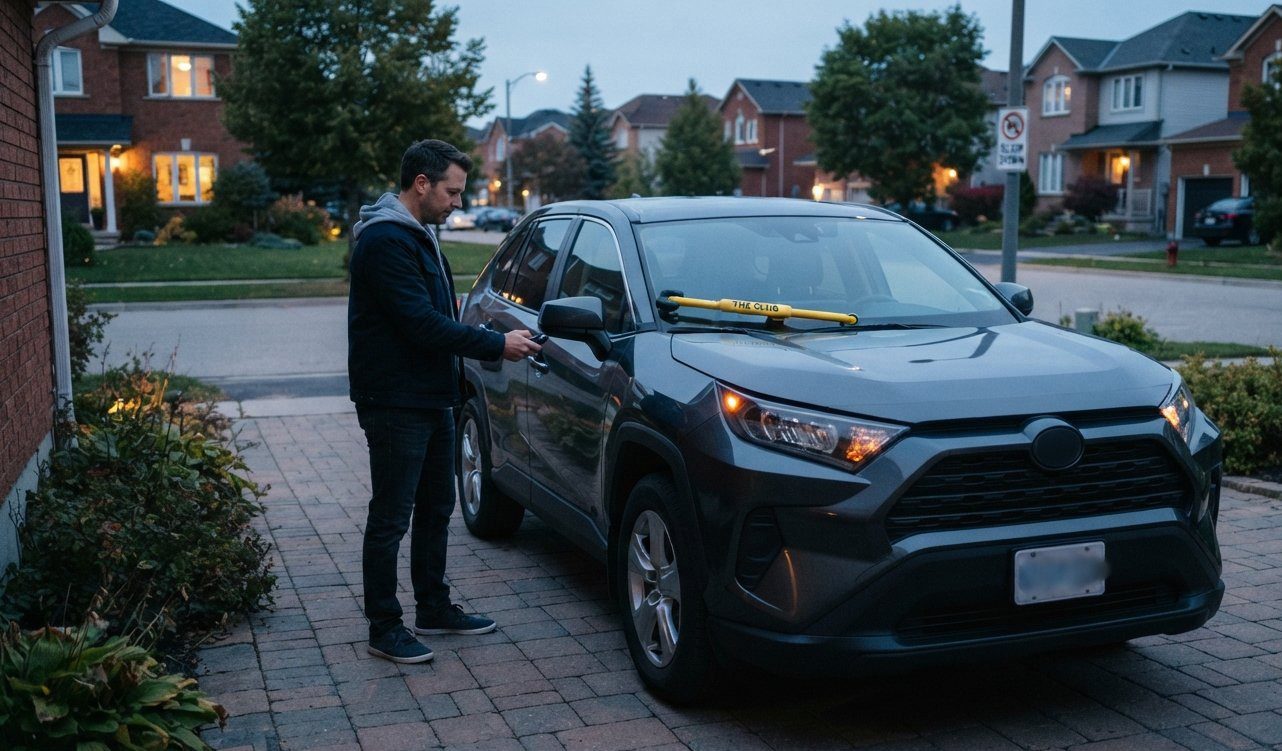
A second layer can include visible deterrents such as a steering-wheel lock, brake or wheel lock, alarm or an OBD2 port lock.
For vehicles with keyless entry, an RFID-blocking or Faraday-style pouch can help reduce exposure to certain key-fob relay attacks.
More advanced layers include an aftermarket immobilizer and a vehicle-tracking system.
IBC recommends speaking with the insurer before installing aftermarket security equipment, and drivers should also check whether modifications could affect a manufacturer’s warranty.
Can an anti-theft device lower your insurance?
Possibly, depending on the insurer and device.
IBC lists installation of a theft-deterrent system among the steps drivers can discuss with their insurer when looking for ways to reduce premiums.
But a discount should not be assumed before the device is installed.
Insurers have different underwriting rules, approved technologies and discount programs.
The practical approach is to contact the insurance company or broker first, ask which security devices qualify and compare the price of the equipment with any potential insurance savings.
What happens if your vehicle is stolen?
A driver should report the theft to police and then contact the insurance provider as soon as practical.
Coverage for theft generally falls under optional comprehensive-type coverage rather than the mandatory liability coverage required to operate a vehicle.
The exact terminology and coverage rules vary by province and policy.
This is another reason drivers should check what their existing policy actually includes before a theft occurs rather than assuming every insured vehicle has the same protection.
Newcomers should separate licensing, registration and insurance
Owning a car in Canada involves several separate requirements.
A driver’s licence establishes permission to drive, vehicle registration connects the vehicle with the provincial registration system, and insurance provides the required financial coverage.
For people arriving with an overseas licence, Maple Curiosity’s foreign driver’s licence exchange guide explains how licensing rules vary across provinces.
In Alberta, the registration process is covered separately in How to Register a Car in Alberta 2026.
None of those processes replaces the others.
Canada is also considering stronger vehicle security standards
The federal government’s September update says work is underway on proposed changes to Canada’s vehicle safety standards for immobilization and theft protection.
The stated objective is to modernize vehicle security requirements as theft methods become more technologically sophisticated.
That is separate from the steps an individual owner can take today.
Existing vehicles will not suddenly become impossible to steal simply because regulatory standards are being reconsidered.
The national trend is better, but risk remains local and vehicle-specific
A 10.1% first-half decline is positive, but it should not be interpreted as a 10.1% reduction in every driver’s personal theft risk.
Risk varies by city, neighbourhood, vehicle model and theft method.
The same applies to insurance.
National claims trends can eventually affect the insurance market, but individual premiums continue to depend on the driver, vehicle, coverage and local claims experience.
For consumers, the useful takeaway is therefore two-sided: Canada’s overall auto theft numbers have improved, while basic theft prevention and vehicle-specific insurance research still matter.
Leave a Reply