Canada’s economy did not shrink in July 2026, but it did not grow either.
Statistics Canada reported that real gross domestic product by industry was essentially unchanged during the month after three consecutive months of expansion. The headline number was 0.0%, but the industries underneath it moved in very different directions.
Construction increased 1.3%, utilities rebounded and several service industries expanded. At the same time, retail trade fell 1.0%, manufacturing declined 0.9% and oil and gas extraction edged lower.
That makes July less a story about the entire economy stopping and more a story about growth becoming increasingly uneven.
Canada’s July GDP was flat, but half of major sectors still grew
According to Statistics Canada’s July 2026 GDP by industry release, 10 of the 20 major industrial sectors expanded during the month.
Goods-producing industries were essentially unchanged overall because gains in construction and utilities were offset by declines elsewhere.
Services-producing industries were also roughly flat, with growth in several professional and consumer-service categories cancelled out by weaker retail and wholesale activity.
That distinction matters. A 0.0% monthly GDP number does not mean every industry experienced zero growth.
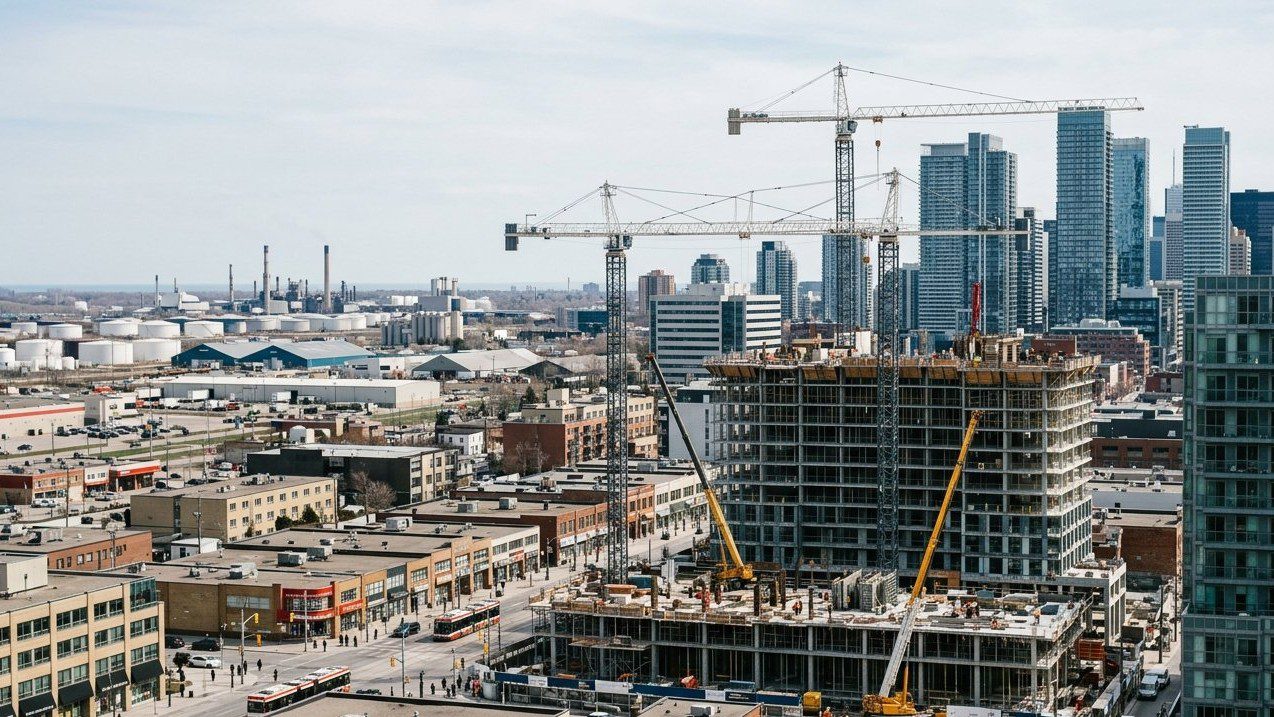
Construction was one of the strongest parts of the economy
Construction output rose 1.3% in July, marking a fourth consecutive monthly increase.
All construction subsectors expanded.
Non-residential building construction increased 2.9%, its strongest monthly growth since January 2022, while residential building construction rose 0.9%.
Statistics Canada said residential growth reflected increased home alterations and improvements as well as higher construction activity across most dwelling types.
This is useful context alongside Canada’s recent housing-supply numbers. Maple Curiosity’s look at record rental construction in 2026 explains why a large construction pipeline can coexist with expensive rents on newly completed apartments.
Housing starts, projects under construction and construction-sector GDP measure different stages of the housing system, but together they show that residential building activity remains an important contributor to economic output.
Retail trade moved in the opposite direction
Retail trade output fell 1.0% in July.
Gasoline stations and fuel vendors recorded a 3.5% decline, while general merchandise retailers fell 2.2%. Motor vehicle and parts dealers also declined.
Statistics Canada noted that gasoline prices were rising rapidly during the peak summer travel period, which coincided with weaker activity at gasoline stations and fuel vendors.
The GDP figures line up with separate retail-sales data showing that Canadian retail sales fell 0.7% in July.
There was an important regional difference, however. Alberta retail sales increased even while the national total declined. Maple Curiosity’s July retail sales analysis breaks down that contrast in more detail.
Manufacturing fell after three months of growth
Manufacturing output declined 0.9% in July, its first decrease in four months.
Non-durable manufacturing fell 1.3%, while durable manufacturing decreased 0.5%.
The petroleum and coal product manufacturing subsector was one of the largest contributors to the decline, falling 5.7%. Statistics Canada linked part of the weakness to unplanned downtime at a refinery in southwestern Ontario.
Machinery manufacturing also fell sharply, declining 5.1% after increasing the previous month.
This helps explain why a flat national GDP number should not automatically be interpreted as weak consumer spending alone. Industrial production also played an important role.
Oil and gas extraction edged lower, but oil sands output increased
The mining, quarrying and oil and gas extraction sector contracted 0.5% in July.
Oil and gas extraction itself declined 0.3%.
However, the Alberta-relevant detail is that oil sands extraction increased 0.2%, while conventional oil and gas extraction fell 0.7%.
That difference matters because national energy-sector data can hide very different movements between oil sands production, conventional extraction, mining and related support industries.
For Alberta households and businesses, the province’s economic conditions also depend on employment, energy investment, migration and consumer activity rather than one national GDP measure alone. Maple Curiosity’s July Alberta job-vacancy analysis provides another view of the province’s labour-market conditions.
Some service industries continued to expand
Professional, scientific and technical services grew 0.3% in July, the strongest monthly increase for the sector since November 2024.
Architectural, engineering and related services helped lead the increase, which also fits with stronger construction activity.
Real estate and rental and leasing expanded 0.2%, while accommodation and food services increased 0.8%.
Traveller accommodation was particularly strong as international arrivals increased.
These gains were not large enough to overcome declines elsewhere, but they show that domestic economic activity was not uniformly weakening.
Why July’s 0.0% does not contradict stronger second-quarter GDP
Canada’s second-quarter GDP had previously shown stronger growth.
That is not a contradiction.
The quarterly GDP figure and the monthly GDP-by-industry measure examine the economy using different frameworks and different time periods.
Statistics Canada reported that real GDP by expenditure increased 0.8% in the second quarter of 2026, helped by exports, household spending and business investment.
July then marked the first month of the third quarter.
A strong second quarter followed by a flat July therefore suggests that momentum slowed at the beginning of the new quarter rather than showing that the earlier growth did not occur.
Statistics Canada’s early August estimate points to modest growth
Statistics Canada’s advance estimate indicates that real GDP increased approximately 0.2% in August.
The agency said increases in mining, quarrying and retail trade were partially offset by lower oil and gas extraction.
The estimate is preliminary.
The official August GDP data are scheduled for release on October 30, 2026, and the number can be revised when more complete information becomes available.
That means the 0.2% figure is useful as an early signal, but it should not be treated as a final result.
What does the July GDP report mean for households?
For most households, a single monthly GDP figure does not immediately change a mortgage payment, grocery bill or paycheque.
Its value is in showing where economic momentum is building and where it is weakening.
Construction remained relatively strong in July, but consumer-facing retail activity softened and manufacturing moved lower. The labour market, inflation, interest rates and household income will determine how those industry changes eventually affect individual families.
Canada’s broader economic picture therefore requires more than one number. Maple Curiosity’s Canada Economic Outlook 2026–2027 brings together employment, inflation, housing and newcomer costs for a wider view.
The next GDP release will show whether July was a pause or a weaker trend
July’s 0.0% result followed three months of expansion, while the preliminary August estimate points to renewed growth of about 0.2%.
If that estimate is confirmed, July may look more like a temporary pause than the beginning of a broad contraction.
If later data are revised lower, the picture could change.
For now, the July report shows an economy moving at different speeds: construction remained strong, retail and manufacturing weakened, oil sands output edged higher and several service industries continued to expand.
Leave a Reply