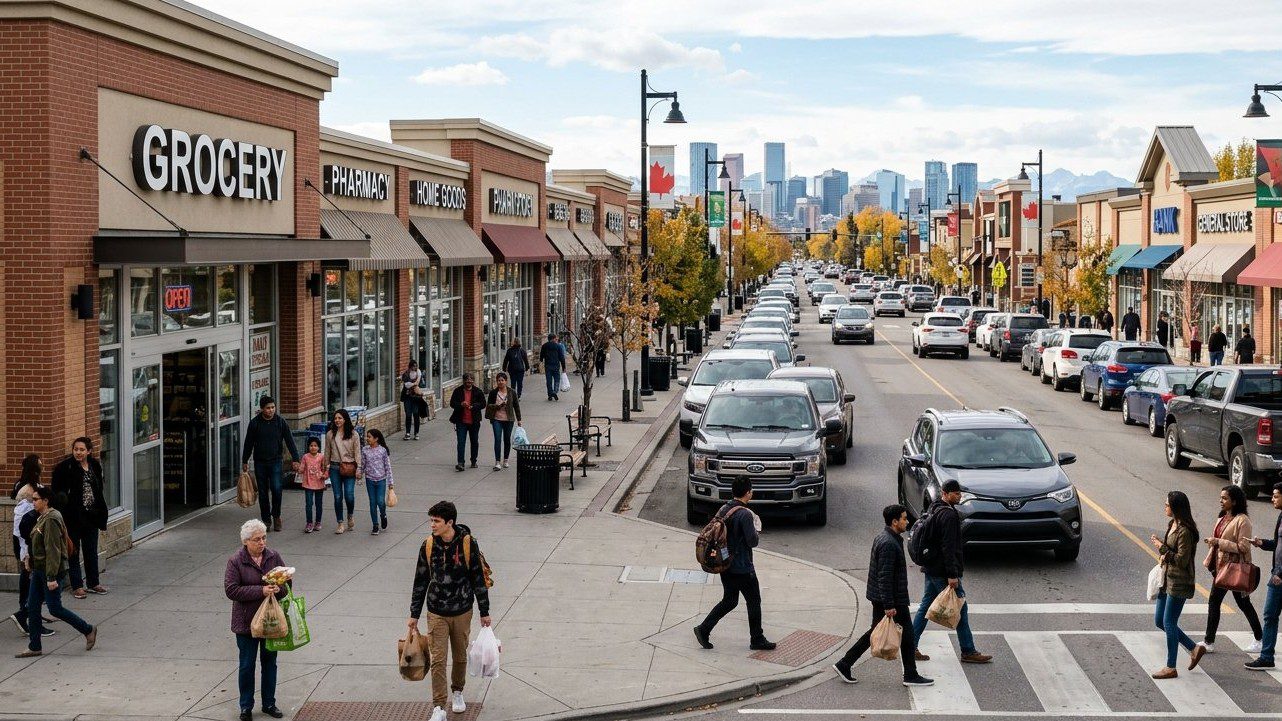
Canadian consumers spent less at retailers in July, but Alberta moved against the national trend.
Statistics Canada reported on September 24 that retail sales across the country declined 0.7% to $73.7 billion in July 2026.
Sales fell in eight of nine retail subsectors.
Alberta, however, recorded a 1.4% monthly increase—the largest increase among the provinces.
Retail sales fell in both dollars and volume
Statistics Canada’s July 2026 retail trade report shows a decline in both the dollar value and physical volume of retail sales.
Current-dollar sales fell 0.7%.
After adjusting for prices, retail sales volumes fell 1.1%.
The distinction matters.
A fall in dollar sales can happen because consumers buy fewer goods, prices fall, or both. Volume estimates attempt to remove the effect of changing prices and provide a clearer view of the quantity of goods sold.
Core retail sales also declined 0.7%
Statistics Canada also publishes a core retail measure that excludes gasoline stations and fuel vendors as well as motor vehicle and parts dealers.
Core retail sales fell 0.7% in July after increasing 1.2% in June.
The largest decline came from general merchandise retailers, where sales fell 1.9%.
Clothing, footwear, jewelry, luggage and related retailers were also down 1.2%.
The only increase among core retail subsectors was at building material and garden equipment and supplies dealers, where sales increased 0.8% for a fourth consecutive month.
New-car sales weakened
Motor vehicle and parts dealer sales fell 0.8% in July.
That was the first monthly decrease in the category in four months.
New car dealers led the decline with sales down 1.3%.
Used car dealers moved in the opposite direction, posting an increase of 2.9%.
For households, those figures describe retail activity rather than vehicle affordability by themselves.
A car purchase also involves financing, insurance, registration and ongoing operating costs.
Maple Curiosity’s Car Insurance in Canada 2026 guide looks at another major part of vehicle ownership costs.
Gasoline-station sales also declined
Sales at gasoline stations and fuel vendors fell 0.9% in July.
It was the second consecutive monthly decline.
In volume terms, gasoline and fuel sales fell a larger 3.5%.
That difference illustrates why retail-dollar figures should not be read only as a measure of consumer demand. Fuel prices can change the dollar value of sales even when the amount purchased moves differently.
Alberta drivers also experience meaningful price differences between cities. Maple Curiosity’s guide to gas-price differences in Edmonton, Calgary and other Alberta cities explains the role of taxes, wholesale conditions and local competition.
Alberta retail sales rose to $9.7 billion
Alberta was one of the provinces that moved against the national decline.
Retail sales increased 1.4% to approximately $9.7 billion in July.
Statistics Canada says the provincial increase was led by higher sales at general merchandise retailers.
This is particularly notable because general merchandise sales declined nationally during the same month.
The figures reinforce the idea that Canada’s regional economies can behave differently even during the same national economic cycle.
Ontario recorded the largest provincial decline
Ontario retail sales fell 2.0% in July.
Statistics Canada says lower general merchandise sales were an important part of the decline.
Within the Toronto census metropolitan area, retail sales fell 4.7%.
British Columbia also declined, with provincial retail sales down 1.4% and Vancouver sales down 1.6%.
By comparison, Alberta’s 1.4% increase makes the provincial divergence particularly visible.
Alberta’s population growth provides useful context
Consumer spending depends on income, prices, confidence and credit conditions, but population size also matters.
Alberta continues to be Canada’s fastest-growing province.
Maple Curiosity’s Canada Population 2026 article examines the newest Statistics Canada estimates showing Alberta passed 5.1 million residents.
A growing population creates more potential customers for retailers, although population growth alone does not explain a single month’s sales increase.
E-commerce sales dropped 3.5%
Canadian retail e-commerce sales declined 3.5% in July to $5.5 billion.
Online retail accounted for 7.5% of total retail trade, down from 7.7% in June.
The Statistics Canada measure does not include every transaction Canadians complete online.
For example, some travel bookings, event tickets and financial transactions fall outside the retail trade definition.
So the 7.5% figure should not be interpreted as saying only 7.5% of all consumer spending in Canada takes place online.
The July decline does not necessarily mean August also weakened
Statistics Canada publishes an early advance estimate to provide a first indication of the following month.
The current estimate suggests Canadian retail sales increased 1.3% in August.
But this is preliminary.
The estimate was produced using responses received from 57.8% of the companies surveyed, compared with an average final response rate of 87.1% over the previous 12 months.
The August estimate can therefore be revised substantially when complete data are published.
Why retail data matter for the economy
Retail sales provide one window into household spending.
When consumers reduce purchases across many categories, businesses may respond with changes to inventories, staffing and investment.
When spending increases, the opposite can occur.
But retail trade does not measure all consumer spending.
Services such as rent, many healthcare expenses, financial services and numerous travel purchases are not captured in the retail sales total.
It is therefore one economic indicator rather than a complete measure of household financial health.
Households may feel very different from the headline number
A family whose grocery, rent and insurance costs continue to rise may not feel that a national retail decline represents weaker spending.
People can reduce discretionary purchases while still spending heavily on necessities.
Maple Curiosity’s Canadian grocery savings guide looks at practical strategies such as flyer comparison, loyalty programs and price matching.
For Alberta specifically, the Alberta Grocery Prices 2026 analysis provides additional context on food costs.
What to watch next
Statistics Canada will release complete August retail trade data on October 23.
The key question will be whether the preliminary 1.3% rebound survives revision.
For Alberta, another point to watch is whether the province continues to outperform the national retail trend as population and labour-market growth remain comparatively strong.
July’s numbers show that Canada’s retail sector softened overall, but the weakness was not evenly distributed across the country.
Leave a Reply