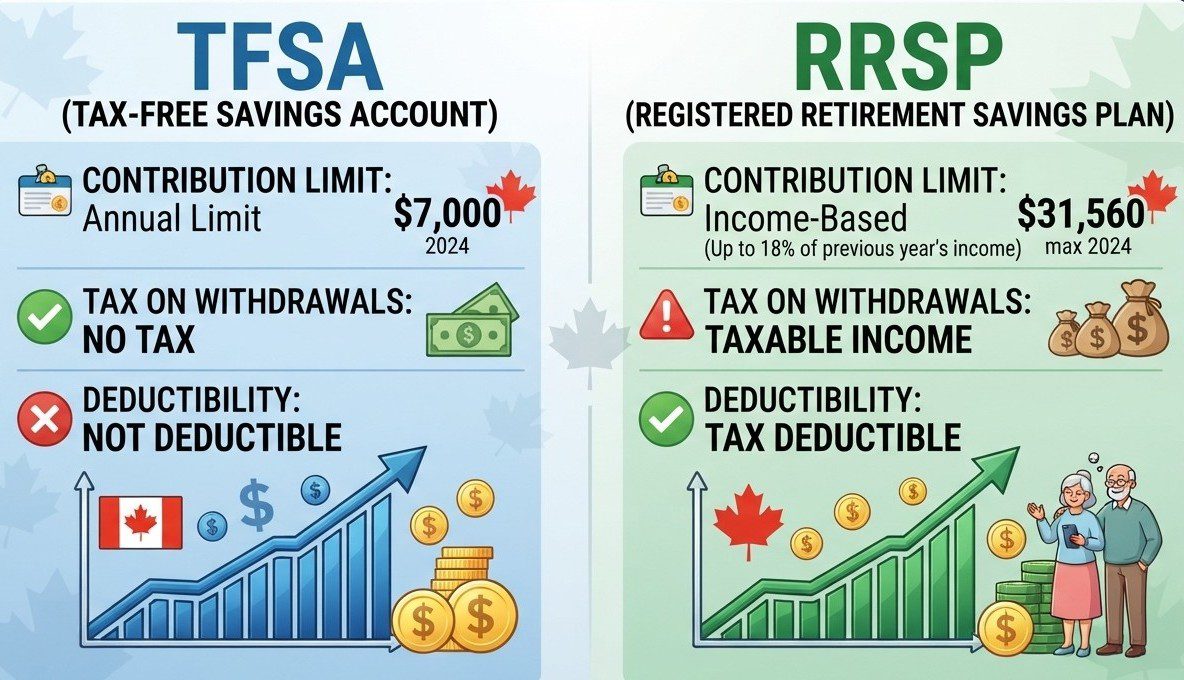
A TFSA and an RRSP can both hold investments, but the tax treatment is different. A TFSA does not provide a deduction when money goes in, while eligible withdrawals are generally tax-free. An RRSP can provide a deduction for eligible contributions, while regular withdrawals are generally taxable.
For 2026, the TFSA annual dollar limit is $7,000 and the RRSP dollar limit is $33,810. Neither number should be treated as an automatic personal contribution limit. Available TFSA room depends on contribution history, withdrawals and years of Canadian residency, while RRSP room depends on CRA’s individual calculation.
TFSA vs RRSP: The Core Difference
| Feature | TFSA | RRSP |
|---|---|---|
| Contribution deduction | No | Generally available for eligible deductible contributions |
| Growth while funds remain in the account | Generally tax-free | Generally tax-deferred |
| Regular withdrawals | Generally tax-free | Generally taxable |
| Withdrawal room restored | Generally added back in the following calendar year | Generally not restored |
| 2026 annual dollar limit | $7,000 | $33,810 RRSP dollar limit |
| Unused room | Carries forward | Carries forward |
2026 TFSA Contribution Room
CRA confirms that the 2026 TFSA dollar limit is $7,000. Available room can also include unused contribution room from earlier eligible years and eligible withdrawals made in previous calendar years.
CRA recommends calculating available room using personal financial records because information shown in CRA account services can lag recent transactions.
Current CRA guidance is available at Calculate your TFSA contribution room.
For a detailed explanation of the annual and cumulative limits, see our TFSA Contribution Limit 2026 guide.
TFSA Withdrawals and Re-Contributions
TFSA withdrawals are generally tax-free, but the withdrawn amount does not automatically become new contribution room on the same day.
CRA adds eligible withdrawals back to contribution room in the following calendar year. If someone has already used all available room, withdrawing $10,000 in 2026 does not by itself allow a $10,000 re-contribution later in 2026.
CRA explains the rule at Withdrawing from a TFSA.
TFSA Room for New Residents
A newcomer does not receive TFSA room for every year since the program began.
For an eligible person age 18 or older, TFSA room generally begins accumulating for years in which the person is a Canadian resident for income-tax purposes.
That means someone who first becomes a Canadian resident in 2026 should not assume they have all historical TFSA room dating back to 2009.
TFSA Over-Contributions
CRA generally applies a tax of 1% per month on an excess TFSA amount while the excess remains in the account.
Foreign-currency contributions also count toward TFSA room in Canadian dollars. Financial institutions convert the contribution using the exchange rate on the transaction date when reporting it to CRA.
See Before you contribute to a TFSA.
2026 RRSP Dollar Limit
The federal RRSP dollar limit for 2026 is $33,810. This is the annual maximum used in the RRSP room calculation; it is not automatically the amount every person can deduct or contribute.
New RRSP room is generally based in part on the previous year’s earned income, subject to the annual limit and adjustments such as pension adjustments. Unused RRSP deduction room can carry forward.
CRA publishes the annual limits at Registered plan limits.
How RRSP Tax Deferral Works
Eligible RRSP contributions can be deducted from taxable income up to the available deduction limit.
Investment income is generally not taxed while it remains inside the RRSP. Regular withdrawals are generally included in income and are subject to withholding tax when paid out.
CRA notes that the tax withheld at the time of withdrawal may be less than the final tax owing after the amount is included on the annual tax return.
See Making withdrawals from an RRSP.
RRSP Withdrawals Usually Do Not Restore Contribution Room
Unlike a TFSA withdrawal, an ordinary RRSP withdrawal generally does not create new RRSP contribution room later.
Special programs such as the Home Buyers’ Plan and Lifelong Learning Plan have their own withdrawal and repayment rules and should be considered separately from ordinary RRSP withdrawals.
RRSP Excess Contributions
RRSP excess-contribution rules are not identical to TFSA rules. A limited $2,000 over-contribution cushion can apply before the 1% monthly excess-contribution tax begins, subject to CRA rules.
The $2,000 amount is not an extra RRSP deduction. It is a buffer in the excess-contribution tax rules.
Effect on Federal Income-Tested Benefits
CRA states that TFSA income and withdrawals do not affect federal income-tested benefits and credits such as Old Age Security, the Guaranteed Income Supplement, Employment Insurance, the Canada Child Benefit and the Canada Workers Benefit.
Ordinary RRSP withdrawals are different because they are generally included in taxable income. That reported income can affect calculations that depend on net income or adjusted family net income.
CRA’s TFSA explanation is available at What is a TFSA?.
Employer Retirement Plans
Employer retirement plans can affect the comparison because group plans may include employer contributions and pension adjustments.
A pension adjustment can reduce the amount of new RRSP room created for the following year. Employer matching arrangements also change the total compensation associated with an employee contribution.
The exact result depends on the employer plan, so the plan documents and CRA deduction limit remain the relevant sources.
First-Time Home Buyers Also Have the FHSA
For an eligible first-time home buyer, the choice is not limited to a TFSA or RRSP.
An FHSA can provide a deduction for eligible contributions and allow qualifying withdrawals for a first home without including those withdrawals in taxable income.
See our FHSA Canada 2026 guide and FHSA vs Home Buyers’ Plan 2026 guide.
TFSA and RRSP Are Accounts, Not Investments
A TFSA or RRSP can hold qualified investments such as cash, GICs, bonds, mutual funds, ETFs and many exchange-listed securities, depending on the account and financial institution.
The tax treatment of the account and the investment risk of what is held inside it are separate questions.
For brokerage and investment-account basics, see our How to Buy Stocks in Canada 2026 guide.
What does an RRSP deduction actually save? A $5,000 example
An RRSP deduction can look attractive in the year it is claimed, but the tax result depends on both the contribution year and the withdrawal year. The table below deliberately keeps investment returns at zero to isolate the tax difference.
| Illustrative step | RRSP | TFSA |
|---|---|---|
| Amount deposited | $5,000, assuming available RRSP deduction room | $5,000, assuming available TFSA room |
| Tax treatment on contribution | If fully deducted at a 30% marginal rate, illustrative tax reduction = $1,500 | No contribution deduction |
| Later withdrawal if marginal rate were 20% | Illustrative $1,000 tax on $5,000 withdrawal; $4,000 remains | Generally $5,000 received tax-free |
This is not a fair comparison of total after-tax wealth by itself: the RRSP contributor also received a $1,500 deduction benefit that may be saved or invested, and the initial cost of funding each account can differ. With a 30% rate on contribution and 20% on withdrawal, the RRSP defers tax and can benefit from a lower future rate. With equal rates and comparable investing, the differences may shrink substantially.
Decision guide: compare your current and expected future marginal tax rates, whether you can reinvest the RRSP tax saving, available contribution room, how withdrawals could affect income-tested benefits, and whether you need the money before retirement. The answer is not automatically ‘RRSP for a refund’ or ‘TFSA for everyone.’ For exact room, rely on your individual CRA records rather than the annual maximum alone.
TFSA vs RRSP 2026: Key Numbers
| Item | 2026 Rule |
|---|---|
| TFSA annual dollar limit | $7,000 |
| RRSP dollar limit | $33,810 |
| TFSA withdrawal room | Generally restored in the following calendar year |
| Ordinary RRSP withdrawal | Generally taxable and does not restore contribution room |
| TFSA excess tax | Generally 1% per month on the excess amount |
| RRSP excess tax | Generally 1% per month after the applicable $2,000 cushion |
Frequently Asked Questions
What is the TFSA limit for 2026?
The annual TFSA dollar limit is $7,000. Individual available room can differ because of unused room, prior-year withdrawals and years of Canadian residency.
What is the RRSP limit for 2026?
The 2026 RRSP dollar limit is $33,810. Your personal RRSP deduction limit can be lower or higher than the amount of new room created in one year because unused room carries forward.
Are TFSA withdrawals taxable?
Eligible TFSA withdrawals are generally tax-free in Canada.
Are RRSP withdrawals taxable?
Ordinary RRSP withdrawals are generally included in taxable income.
Does a TFSA withdrawal create room immediately?
No. The withdrawn amount is generally added back to contribution room in the following calendar year.
Does a newcomer get TFSA room dating back to 2009?
No. TFSA room generally begins for eligible years in which the person is a Canadian resident for income-tax purposes.
Disclaimer: TFSA and RRSP contribution room, deductions and withdrawals depend on individual records and tax circumstances. Confirm available room and current rules with CRA before making a large contribution or withdrawal.
Leave a Reply