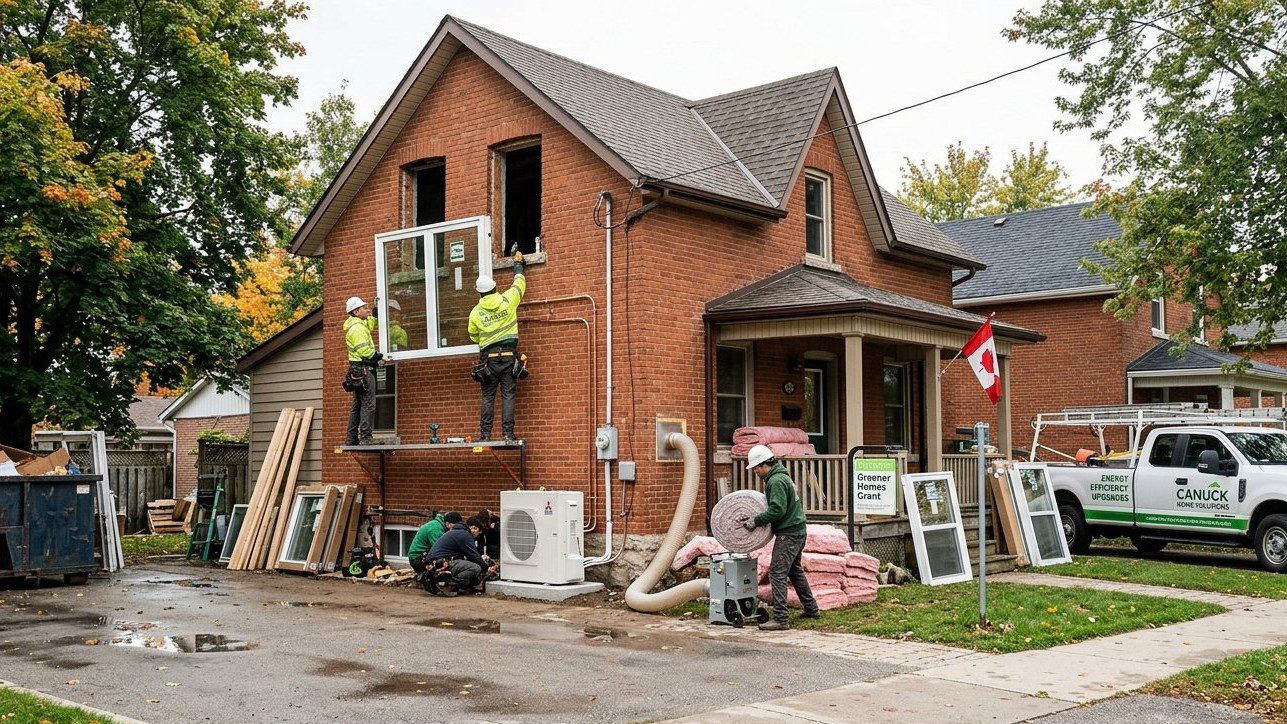
Canada has announced a new national heat-pump rebate that could cover up to $10,000 of the cost for eligible lower-income homeowners.
On October 8, 2026, the federal government announced a $2 billion investment over eight years to support one million home retrofits across Canada. The centrepiece is a National Heat Pump Rebate designed to help up to 820,000 homeowners install eligible electric cold-climate air-source heat pumps.
Households below the median income will be eligible for rebates of up to $10,000. Other eligible homeowners can receive $2,000. The federal government says the rebates can be combined with existing provincial programs.
The new program is designed to be simpler than earlier federal retrofit programs: no pre- or post-installation energy audit will be required, eligible heat pumps must come from an approved product list, and the government says pre-approval should be available within 24 hours.
Who can get the new federal heat-pump rebate?
The October 8 federal backgrounder sets out two rebate levels.
- Up to $10,000 for eligible households below the median income.
- $2,000 for other eligible homeowners.
To qualify, the heat pump must be on the federal Eligible Products List. The government says the list includes more than 100,000 options and configurations designed for Canadian climates.
Only one rebate will be issued per person. For example, a landlord who uses the rebate for a rental property cannot also claim another rebate for a heat pump at their own residence.
No home energy audit will be required
Unlike some previous federal retrofit programs, the new National Heat Pump Rebate will not require a pre-installation or post-installation home energy audit.
The planned application process is online. Homeowners will provide basic personal information and details about the eligible heat pump they intend to purchase.
The government says applications should be approved within 24 hours. After the pre-approved equipment is purchased and installed, the homeowner will upload receipts and payment approval is expected within five days.
That does not mean every applicant will automatically be approved. Income eligibility, the equipment chosen and the final program rules will still matter.
How much could a heat pump save on energy bills?
The federal government estimates average savings of more than $1,400 per year for households that currently heat with oil, propane or electric resistance systems such as electric furnaces or baseboards.
That figure is an average estimate, not a guaranteed saving for every home. Actual results depend on climate, electricity prices, the existing heating system, house efficiency, equipment sizing and installation quality.
Heat pumps also provide cooling, so the value can include replacing or reducing the need for a separate air-conditioning system.
Apartment buildings are included in the wider retrofit plan
The $2 billion announcement is not limited to detached homeowners.
The federal government is also working with the Canada Mortgage and Housing Corporation and the Canada Infrastructure Bank to support retrofits in 280,000 apartment and multi-unit residential units over eight years.
CMHC is expected to support up to 250,000 units through a mortgage-loan-insurance product that helps building owners access private financing on more favourable terms. The Canada Infrastructure Bank will target another 30,000 units through its Building Retrofits Initiative.
The government is also renewing the Deep Retrofit Accelerator Initiative with nearly $110 million over three years beginning in 2027-28.
This is separate from the $66.3 million municipal retrofit funding announced October 2
Six days before the national heat-pump announcement, Ottawa announced another $66.3 million for residential energy-efficiency and affordable-housing projects through the Green Municipal Fund.
The October 2, 2026 announcement covers 162 projects through the Green Municipal Fund, including programs designed to help homeowners finance insulation, windows, air sealing, heat pumps and other energy-saving improvements.
There is one important detail homeowners should understand before assuming a new federal rebate has opened.
This is not one nationwide $66.3 million cash-rebate program where every Canadian homeowner can apply directly to the federal government.
Much of the funding goes to municipalities and local organizations that create or expand their own financing and retrofit programs.
What exactly did Canada announce?
The funding is divided between two Green Municipal Fund initiatives.
Approximately $34.6 million is going to Community Efficiency Financing projects.
Approximately $31.7 million is going to Sustainable Affordable Housing projects.
Together, the programs account for approximately $66.3 million across 162 projects.
The projects are spread across every region of Canada, including 36 projects across the Prairie provinces.
What is Community Efficiency Financing?
Community Efficiency Financing helps municipalities, utilities and local organizations build financing programs for residential energy upgrades.
Instead of a homeowner receiving money automatically from Ottawa, a municipality may use federal-supported funding to create loans, grants or other financing structures available locally.
Eligible upgrades can include:
- home insulation
- air sealing
- high-efficiency windows
- heat pumps
- other measures that reduce residential energy consumption
The exact program structure depends on the local organization delivering it.
Alberta is included in the new funding
Several Alberta projects are part of the October announcement.
The Town of Drayton Valley is receiving approximately $1.44 million for a Clean Energy Improvement Program.
The Town of Okotoks is receiving approximately $1.72 million for its own residential energy-efficiency financing program.
Both use a property-based financing approach designed to help homeowners pay for eligible upgrades over time.
A separate project in Banff is receiving $250,000 for a feasibility study involving an energy-efficient 85-unit affordable housing development.
What is a Clean Energy Improvement Program?
Alberta’s Clean Energy Improvement Program, often called CEIP, uses a form of property-assessed financing.
Instead of paying the full cost of an eligible improvement upfront, a qualifying homeowner may be able to finance the project and repay the amount through a charge associated with the property.
The details vary by participating municipality.
That means someone living in Edmonton, Calgary, Okotoks or another Alberta community should not assume the same financing terms apply everywhere.
Local eligibility rules, approved contractors, project types, financing limits and repayment periods can differ.
This is financing—not automatically free money
The word “funding” can create confusion.
A federal government announcement worth millions of dollars does not necessarily mean homeowners receive free renovation money.
Some local programs can include grants or incentives.
Others primarily provide loans or long-term financing.
A homeowner should therefore check whether the local program offers a grant, a repayable loan, a combination of both or another form of financing before starting renovations.
The repayment cost also needs to be compared with the expected energy savings.
What kinds of upgrades can reduce household energy bills?
The most useful upgrade depends on the home.
A house with poor insulation may lose substantial heat even if the furnace itself is efficient.
An older home with significant air leakage may benefit from sealing before expensive mechanical equipment is replaced.
Windows can improve comfort and energy performance, but replacing every window can also involve a large upfront cost.
Heat pumps can reduce fossil-fuel consumption and provide both heating and cooling, but the financial benefit depends on climate, electricity prices, existing heating equipment and the specific system installed.
Energy upgrades should therefore be evaluated as a package rather than assuming the most expensive upgrade automatically produces the largest saving.
Energy costs are only one part of housing affordability
Reducing utility bills can help household cash flow, but energy efficiency cannot solve the wider cost-of-living problem by itself.
Mortgage or rent payments generally represent a much larger household expense.
Property taxes, insurance, maintenance, food and transportation also matter.
Maple Curiosity’s Alberta Cost of Living 2026 looks at utilities alongside the other major expenses households need to budget for.
The program also targets affordable rental housing
Not all of the $66.3 million is aimed at individual homeowners.
The Sustainable Affordable Housing portion supports energy-efficient affordable housing projects.
That includes feasibility studies, planning work, pilot projects, retrofits and some capital projects.
One example is a $10 million net-zero carbon retrofit of an affordable multi-residential building in Peel Region, Ontario.
Projects elsewhere in Canada focus on improving the energy performance of existing affordable rental housing or designing new low-carbon housing.
This is relevant because lower operating costs can matter to housing providers as well as individual homeowners.
More efficient buildings do not automatically mean cheaper rent
Energy-efficiency improvements can reduce operating expenses.
But there is no guarantee that an energy-efficient apartment will have a low monthly rent.
Construction costs, land prices, financing and local demand still affect what a housing provider needs to charge.
Canada is already experiencing this tension in the rental market.
Maple Curiosity’s Canada Rental Construction 2026 explains why record levels of new rental construction can coexist with expensive newly built apartments.
Should homeowners renovate just because financing is available?
Access to financing does not automatically make every renovation financially worthwhile.
Before borrowing, homeowners should estimate the total cost, expected lifespan of the improvement and realistic annual energy savings.
A project can also create non-financial benefits.
Better insulation and air sealing can improve comfort.
Heat pumps can add cooling during summer.
New windows can reduce drafts and outside noise.
Those benefits have value even if the project does not completely pay for itself through utility savings.
Home buyers should consider future upgrade costs before purchasing
Energy performance is also worth considering before buying a home.
An older property with a lower purchase price may need expensive improvements soon after closing.
A newer or recently renovated home may have higher upfront pricing but lower near-term maintenance and energy costs.
First-time buyers also need to separate renovation financing from incentives connected with the initial purchase.
Maple Curiosity’s First-Time Home Buyer GST Rebate guide explains the separate federal GST rebate available on qualifying new homes.
How do you know whether a program is available where you live?
The best starting point is the municipality or organization delivering the local program.
Look for information about:
- whether applications are currently open
- which properties qualify
- eligible upgrades
- maximum financing
- interest rates or administrative fees
- approved contractor requirements
- energy-audit requirements
- repayment terms
A national funding announcement may support a local program before that program begins accepting homeowner applications.
Homeowners should therefore verify the local launch date rather than assuming the federal announcement itself is an application opening.
Why this $66.3 million announcement matters
The most important part of the October announcement is not that every Canadian homeowner suddenly has access to a new cheque.
It is that more municipalities are being given the financial tools to build local retrofit programs.
That can make large home improvements easier to finance for households that cannot comfortably pay thousands or tens of thousands of dollars upfront.
The practical value will ultimately depend on where the homeowner lives, what programs become available locally and whether the financing terms make sense for the particular property.
Leave a Reply